
Baby Transitions Between Positions: Why How They Get There Matters
Every milestone your baby reaches, rolling, sitting, crawling, standing, gets most of the attention. The movement between those positions is where coordination, strength, motor planning, and visual tracking all come together. Transitions are how development happens. The destination shows you where your baby arrived. The transition shows you how they got there.
At a Glance: The Four Transitions
Rolling (belly to back and back to belly) — 3 to 6 months. First full-body transition; builds spinal rotation, shoulder strength, and vestibular development.
Into and out of sitting — 6 to 10 months. Develops trunk rotation, core control, and the shoulder stability crawling requires.
Sitting to hands and knees — 7 to 10 months. Bridge to crawling; requires hip mobility, trunk rotation, and upper body weight-bearing.
Floor to stand through half kneel — 9 to 12 months. Builds single-leg strength, hip stability, and the lower body loading that every walking step depends on.
Baby transitioning from sitting to hands and knees, showing the leg tuck, trunk rotation, and hip mobility that bridge sitting to crawling
Age ranges reflect typical developmental windows. For a full reference, check out Moveverys Milestone guide or the CDC’s developmental milestones provide a helpful baseline:
We talk a lot about milestones. When babies roll, when they sit, when they crawl, when they stand. These are the moments we photograph, share, and celebrate.
But here’s what I want every parent to know: the magic is in the in-between.
The transition, the movement your baby makes to get from one position to the next, is where the brain and body learn to work together. It is where coordination is built, where motor planning gets practiced, where trunk strength and visual tracking and weight shifting all have to show up at the same time. The destination tells you your baby arrived. The transition tells you how they got there, and that is the part that shapes everything that follows.
This post walks through the four key transitions in your baby’s first year, why each one matters, what to look for, and how to support your baby through each stage.
What Every Transition Requires
Every transition begins the same way: the eyes lead, the spine rotates, the weight shifts. Visual tracking, spinal rotation, and weight shifting are the initiating sequence, the chain that starts every transition regardless of which positions are involved. What the body draws on to complete each one is bigger: motor planning, coordination, balance, control, and strength all have to show up. And underneath all of it are two organizing principles, stability paired with mobility, and symmetry paired with asymmetry, that show up in every transition from the first roll through the first step.
Visual Tracking
Transitions begin with the eyes. The baby sees something, a toy, a face, a sound source, and turns their head to follow it. That head turn is what initiates the weight shift and rotation that follow. Visual tracking is a developmental milestone in its own right, and it is the spark that starts every transition. This is why toy placement matters so much: where you put the object of interest shapes the direction, timing, and quality of the movement that follows.
Spinal Rotation
Once the head turns, the spine has to rotate for the body to follow. Spinal rotation is what allows the head, shoulders, and hips to move in sequence rather than all at once. It is what separates a smooth, coordinated transition from a stiff, log-like one. You see it when a baby rolls and the head leads before the hips follow. You see it when a baby rotates out of sitting to get onto hands and knees. You see it when a baby brings one foot forward into a half kneel on the way to standing.
Spinal rotation is one of the earliest building blocks that carries into crawling, walking, and the cross-body coordination that underlies almost every complex movement skill. Every time a baby practices a transition, they are practicing rotation.
Weight Shifting
With the head turned and the spine rotating, the body has to shift its weight to let momentum carry the movement through. Tipping slightly to one side, loading one hip or one arm, creating an asymmetry in the body that the transition can follow. Weight shifting is how the body completes what the visual system started, and it is something babies build through floor time, reaching, sidelying, tummy time, and active play in a variety of positions.
Every transition starts with something the baby sees, moves through spinal rotation and weight shifting, and demands motor planning, coordination, balance, control, and strength to complete. When babies practice transitions, they are practicing all of it, every time.
Transitions begin in symmetry and move through asymmetry. Think of a roll: the baby starts flat on their back, symmetric and still. They turn their head, shift their weight, and that asymmetry is what the roll follows. One side stabilizes so the other side can move. This interplay between stability and mobility, and between symmetry and asymmetry, is the pattern that shows up in every transition from rolling through walking.
Why Transitions Matter as Much as the Milestone
Every time your baby moves from one position to another, their body is doing more than getting from place to place. Here is what is actually happening:
Core and trunk strength. Moving through a transition requires active muscle work from the core, trunk, and hips. Babies who earn their way into positions build this foundational strength. Babies who are placed into positions skip the movement that builds it.
Motor planning. Every transition is a multi-step movement sequence. The brain plans and executes it, and gets better with every repetition. Every roll, every push to sitting, every step through a half kneel is practice.
Coordination. The right muscle groups have to activate in the right sequence, at the right time. That communication between brain and body is coordination being built from the ground up.
Balance and postural control. Transitions demand that one part of the body stabilize while another part moves. That is the core of balance: not holding still, but managing movement. Every transition is balance training.
Shoulder and arm strength. Floor-based transitions are the primary window for building shoulder and arm strength. Pushing up in tummy time, pushing through an arm to get into sitting, and bearing weight on all-fours each load the shoulder girdle in ways upright movement does not. Once babies are walking, that window closes.
Babies who earn their way into positions build the strength, rotation, and motor planning the position requires. That practice does not just show up in the current transition. It shows up in every transition that follows.
The Four Transitions That Shape Your Baby’s First Year
1. Rolling: Belly to Back and Back to Belly
Rolling is your baby’s first experience with a full-body transition. It is the first time the brain has to coordinate the head, trunk, and hips into a sequence of movement, and the first time the body receives meaningful vestibular input, the sensory information the brain receives from the inner ear about head position, movement, and balance, from rotating through space.
The roll itself is the transition. Tummy to back is the more extension-dominant direction: the baby lifts the head, extends through the arms and shoulders, and the body tips over from that extended position. Visual tracking initiates the weight shift, and the push through the arm and shoulder is the first time the upper body actively loads during a full-body movement, building the shoulder girdle strength that every transition forward will depend on.
Back to belly is more flexion-driven. The leg has to cross the midline, which requires hip flexion, and neck rotation initiates the whole sequence. Visual tracking draws the head to turn, the neck rotates to follow, and that initiates the leg crossing and the trunk rotation that carries the body over with the trailing arm reaching across. Both directions begin with what the baby sees, and both build something different on the way through.
Lower extremity dissociation, the ability of each leg to do something different at the same time, is what allows the roll to complete. In sidelying, one leg extends while the other stays flexed. That separation, one leg long and one leg bent, is what creates the space on the weight-bearing side that lets the body carry all the way over. When both legs stay together through the roll, that independence is missing, and the roll either stalls in sidelying or completes as a log without the rotational sequence.
What to watch for: rolling that looks stiff and log-like, where the whole body rotates as one unit without spinal rotation, is worth paying attention to. Segmental rolling, where the head leads, the shoulders follow, and the hips unwind last, is the pattern that builds the trunk rotation every future transition depends on.
Learn more about rolling, what it requires, and how to support it →
2. Transitions Into and Out of Sitting
This is the transition I want parents to think about most. Independent sitting gets celebrated, and it should. But the ability to get into and out of sitting independently is even more important, and it is the piece that often gets skipped.
Getting into sitting from the floor requires trunk rotation. The baby rotates through the spine, shifts their weight onto one hip, pushes through an arm, and arrives in sitting through a sequence of movement that demanded something from every part of the body. Getting out of sitting requires the same thing in reverse: rotating over a hip to come down to the floor and into another position.
That push through the arm is active shoulder work. As the baby rotates over one hip, the arm on that side bears weight and pushes the body upright. This is where trunk rotation and shoulder strength start building together, and where the shoulder stability crawling will soon require begins to take shape.
When babies are placed directly into sitting, they arrive in the position but skip the movement that builds it. And when they sit contentedly without transitioning in or out on their own, we call that a happy sitter.
What Is a Happy Sitter?
A happy sitter is a baby who sits well and seems comfortable in the position, but cannot get into or out of sitting independently. It is a term used in the pediatric PT world to describe a pattern worth paying attention to.
A happy sitter often signals that the core and hip stability needed to free the legs from holding the body upright is still developing. The baby is using the legs to stay stable in sitting, so rotating out of the position means risking that base. When they do attempt rotation, it tends to happen between the upper trunk and the rib cage rather than through the full spine, a workaround rather than full rotational control. Over time, this means the rotational core strength that crawling requires does not fully develop.
Shoulder and arm readiness is part of the picture too. A baby who has not had much opportunity to bear weight through the arms may find the all-fours position itself demanding, which adds another reason to stay in the stable sitting base rather than move through it.
You might notice a happy sitter bottom scooting rather than crawling, because scooting allows them to stay in their stable base and move without having to rotate out of it.
Getting into and out of sitting independently should be well established by 9 to 10 months. If your baby is sitting comfortably but not yet moving in and out on their own, that is a good time to reach out for a PT evaluation.
More on sitting development and what each stage looks like →
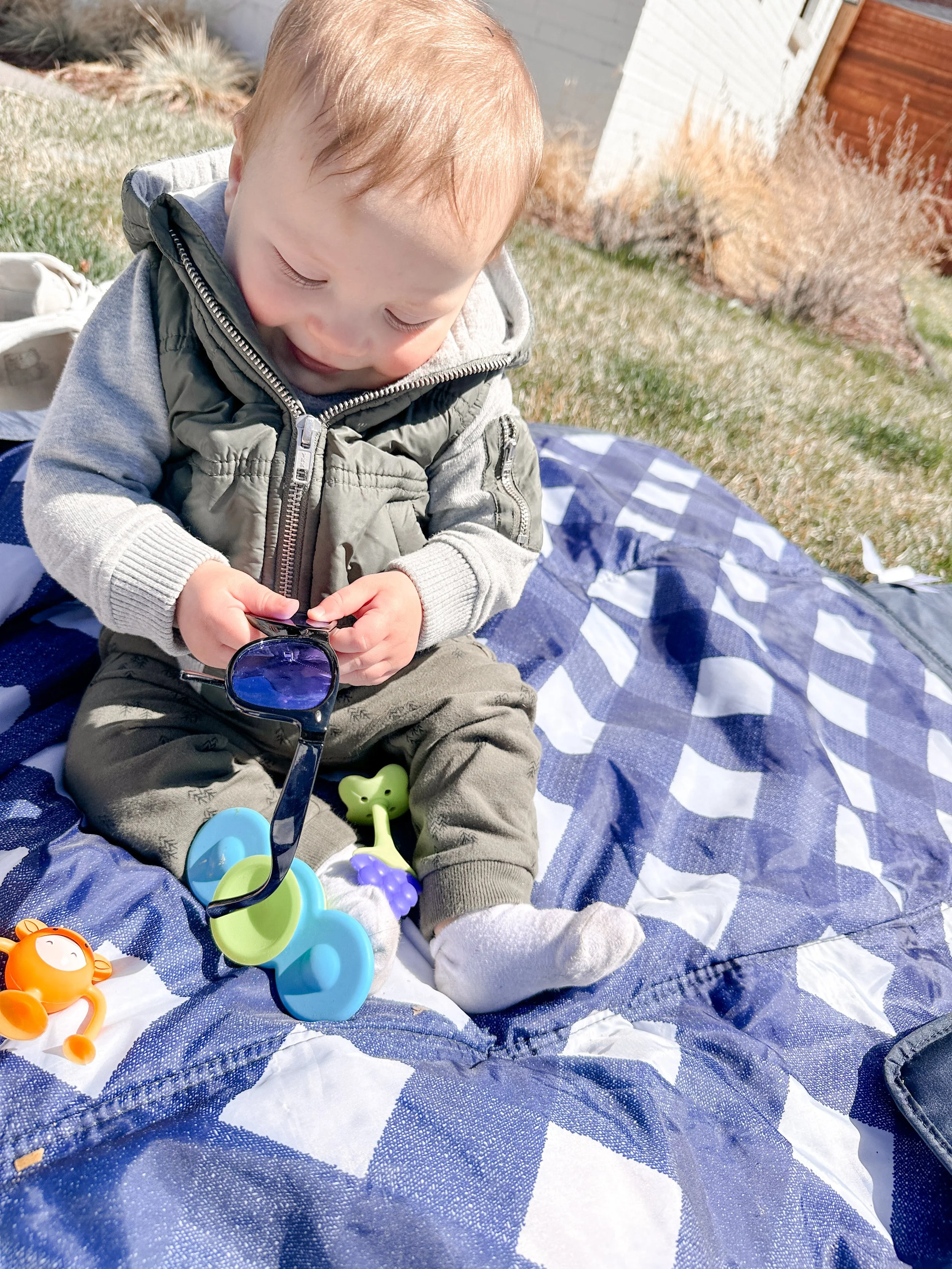
Floor time with toys in reach gives babies the motivation to shift, rotate, and reach — the building blocks of every transition.
3. Sitting to Hands and Knees
The transition from sitting to hands and knees is the bridge to crawling, and it requires true trunk rotation along with significant hip mobility. Here is how it actually happens: the baby tucks one leg and foot under the body while the other leg stays in a ring position, bent, turned out, and away from the body, like a frog leg position, which provides stability to the pelvis. With that stable base in place, the baby moves the pelvis and trunk forward over the lower leg. The trunk stays symmetrically extended as the center of gravity shifts forward, and then the arms come down to bear weight. Hip mobility is essential for this tucking motion to happen cleanly.
Arriving on all-fours places significant load through the hands and arms. The shoulder girdle has to stabilize the body from above while the core and hips hold the base below. Weight shifting from hand to hand in this position, and then in crawling, builds the shoulder strength and stability that no upright activity at this age builds as well. Babies who spend time on all-fours, even rocking back and forth or shifting weight before they crawl, are building an upper body foundation that walking will not replace.
Babies who have developed trunk rotation through rolling and through getting in and out of sitting tend to make this transition fluidly. Babies who have been spending most of their floor time placed in sitting, or who are happy sitters, often find this transition harder because the rotation was not yet fully built.
Getting into and out of sitting independently is the piece that matters most. Watch the rotation over the hip — that sequence is what every transition forward depends on.
You can support this transition by placing toys to the side and slightly behind your baby while they are sitting. The reach to get the toy encourages the rotation that starts the transition to hands and knees. A hand at the hip, rather than at the shoulder, gives gentle guidance toward rotation without taking over the movement.
How crawling builds on these transitions →
The floor-based period is the primary window for shoulder and arm strength. Rolling, pushing into sitting, and all-fours weight-bearing load the shoulder girdle in ways walking does not. Once babies are upright and moving on two feet, the arms shift from weight-bearing to balance and reach. Every floor transition your baby practices before that point is building upper body strength they will carry forward.
4. Floor to Stand: Why Half Kneel Matters
When babies come to standing through a half kneel, they bring one foot forward with the foot flat on the floor, then shift their weight forward onto that leg to rise. The arms play more of a balance role here than a control role: the work belongs to the legs and hips. Specifically, the hip stabilizing muscles, including the glutes, have to be active to keep the pelvis stable as the baby pushes up to standing on one leg. The front leg has to actively push up rather than just accept weight, and that work builds the single-leg strength every walking step will depend on.
When those hip stabilizing muscles are not yet doing their job, you can often see it: the weight shifts toward the inner edge of the foot and the foot rolls inward as the baby rises. That can be a compensation pattern, not a structural foot problem. It tells you the hip is not yet stabilizing the movement the way it needs to.
When babies pull to stand primarily through their arms, hauling themselves up by the furniture with their legs doing minimal work, they arrive in standing but bypass the lower body loading that builds walking readiness.
You can encourage half kneeling by positioning toys at a height that motivates your baby to push through their legs rather than pull through their arms. A low couch cushion or coffee table works well. Support at the hip rather than lifting at the hands. And let the toy do the motivating.
Mobility follows stability. Always. Half kneeling is one of the first places your baby’s lower body builds the single-leg stability that walking will depend on.
When the hip stability is there, the pattern clicks. This is what it looks like when a baby earns their way to standing.
How to Support Transitions at Home
Let Them Earn the Position
Rather than placing your baby into sitting, into standing, or into any position, give them the opportunity to get there on their own. Offer a hand for balance if needed, but let the movement come from them. The rotation, the weight shift, the push-off through an arm or leg: all of that is development happening in real time.
Use a Hand at the Hip
When you are helping your baby roll, rotate out of sitting, or move from sitting to hands and knees, try placing a hand at the hip rather than the shoulder. Rest it gently on the side of the hip or the pelvis and let that contact guide the rotation through the trunk. The shoulder tends to take over and do the rotating for them. The hip keeps the movement theirs.
With support at the hip and lower leg, the baby finds the single-leg push pattern. The front leg does the work.
Let a Toy Do the Work
Motivation is a powerful teacher. A toy placed just out of reach, slightly to the side, behind them, or at the height that requires a push-up rather than a pull-up, asks the body to solve a movement problem. Babies who are reaching for something they want find the transition more efficiently and with more engagement than babies who are being guided through it passively.
Roll Into and Out of Tummy Time
Every time you move your baby, you have an opportunity to practice a transition. Rather than placing your baby directly onto their belly, roll them gently down through their side. When tummy time is over, roll them back the same way. This is the most natural way to build the rolling transition into the daily routine, and it teaches the motor sequence every single time.
Give Plenty of Floor Time
Transitions happen on the floor. The more time babies have to move freely on a firm, flat surface, the more opportunities they have to practice the rotations, weight shifts, and sequences that build toward every milestone. Floor time in a variety of positions, back, belly, side, sitting, all-fours, gives the nervous system the input it needs to keep building.
When Transitions Are Worth a Closer Look
There is a wide range of normal in how transitions develop, and most babies find their own path through each one. These are the patterns worth a closer look with a pediatric PT:
Your baby rolls only to one direction, or rolls as a stiff log without rotation
Your baby sits well but always needs to be placed into sitting and does not move in or out independently by 9 to 10 months
Your baby transitions out of sitting by tipping straight forward rather than rotating over a hip
Your baby pulls to stand primarily through their arms with minimal leg push-off
Movement looks effortful or asymmetrical on one side
Your baby prefers one direction for rolling, reaching, or transitioning
You have a sense that something about how your baby moves feels worth a second opinion
In Colorado, you do not need a physician referral to see a pediatric physical therapist. Movevery offers complimentary discovery calls so you can ask questions before committing to anything.
The Movevery Approach
At Movevery, we look at the whole body: trunk rotation, weight shifting, core strength, neck range of motion, hip mobility, and how everything organizes together during movement. We look at the body holistically because development is holistic. No part of it happens in isolation.
Transitions are a big part of that picture. A baby who can sit but cannot get into or out of sitting independently is showing us something different than a baby who moves fluidly between the floor, sitting, and all-fours. How the body moves between positions tells us what is developing, what is compensating, and where it is ready to go next.
You know your baby best. You notice the details, the preferences, the patterns that show up in everyday moments. Movevery is here to meet you where you are, to offer the clinical picture, the education, and the practical tools that help you feel confident supporting your baby’s development. Parents leave with clear answers and strategies they can use the same day: how to guide a transition, where to place a hand, how to use toys and floor time with intention.
Related Reading
My Baby Isn’t Rolling: What Rolling Actually Requires and When to Seek Support →
When Do Babies Start Sitting? A Stage-by-Stage Guide →
When Do Babies Start Crawling? A Pediatric PT’s Complete Guide →
Baby Not Crawling Yet? Here’s What Every Parent Needs to Know →
About the AuthorDr. Nicole Crippen Schremp, PT, DPT, PCS is a pediatric physical therapist and board-certified Pediatric Clinical Specialist based in Denver, Colorado. She is the founder of Movevery Infant and Pediatric Physical Therapy, where she works with babies and young children to support developmental movement, motor milestones, and the transitions between them.Her approach is grounded in clinical precision and family partnership. She believes parents are the experts on their child, and her job is to give them the tools to support their baby’s development every day.Movevery serves families across the Denver metro area. In Colorado, no physician referral is needed to see a pediatric PT. Discovery calls are complimentary.
Frequently Asked Questions
When do babies transition between positions?
Rolling typically begins between 3 and 6 months. Getting into and out of sitting develops between 6 and 10 months, with independent in-and-out transitions well established by 9 to 10 months. The transition from sitting to hands and knees usually emerges between 7 and 10 months as a bridge to crawling. Floor to stand through a half kneel typically develops between 9 and 12 months. There is a wide range of normal within each window.
What are baby transitions between positions?
Baby transitions are the movements between positions: rolling, getting into and out of sitting, moving from sitting to hands and knees, and coming from the floor to standing. They are where coordination, trunk rotation, weight shifting, motor planning, and visual tracking all develop together.
Why is how my baby gets into a position important?
The movement of getting into a position builds the strength and rotation the position itself requires. Babies who earn their way into positions develop more of this foundation than babies who are placed there. Over time, that practice shapes every transition that follows.
What is a happy sitter?
A happy sitter is a baby who sits well but cannot get into or out of sitting independently. The baby uses the legs to stay stable in sitting, so rotating out means risking that base. Happy sitters often bottom scoot instead of crawl. Getting in and out of sitting independently should be well established by 9 to 10 months.
Why does my baby bottom scoot instead of crawl?
Bottom scooting is often a sign that trunk rotation is still developing. Crawling requires the baby to rotate out of sitting and onto hands and knees, then alternate the arms and legs in a cross-body pattern. A baby who scoots can move without leaving the stable sitting base. It is efficient for them, but it bypasses the rotation and weight-shifting that crawling builds. If your baby is scooting and not showing interest in crawling by 10 months, a PT evaluation can help identify what is still developing.
What is the difference between log rolling and segmental rolling?
Log rolling is when the whole body rotates as one unit, head and trunk and hips moving together without any spinal rotation. Segmental rolling is when the head leads, the shoulders follow, and the hips unwind last, or the lower body initiates and the upper body follows in sequence. Segmental rolling is the pattern that builds the trunk rotation every future transition depends on. Both get the baby from place to place. Only one builds the rotational foundation that follows.
What does it mean if my baby rolls like a log?
Log rolling tells us that spinal rotation is still developing. It is worth paying attention to because rolling is the first opportunity the body has to practice segmental movement, and that rotational pattern carries into every transition that follows. If your baby rolls only in a log-like pattern, a PT evaluation can help identify what is still developing and how to support it.
What is half kneeling and why does it matter for standing?
Half kneeling is when a baby brings one foot forward flat on the floor and pushes up to standing through that leg. The hip stabilizing muscles have to be active to keep the pelvis stable during the rise. When they are not yet doing that job, the foot often rolls inward. Pulling to stand through the arms bypasses this lower body work entirely.
How do I help my baby transition between positions?
Let them earn their way into positions rather than placing them there. Use a hand at the hip rather than the shoulder when guiding a roll or rotation out of sitting. Place toys slightly out of reach and to the side to motivate reaching and rotating. Roll your baby into and out of tummy time rather than placing them directly on their belly.
When should I see a pediatric PT about transitions?
Reach out if your baby rolls only in one direction, cannot transition in or out of sitting independently by 9 to 10 months, pulls to stand primarily through their arms, or if movement looks asymmetrical or effortful. Trust what you observe. In Colorado, no referral is needed. Movevery offers complimentary discovery calls.
Does sitting a baby up early affect their development?
Placing a baby in sitting before they can get there on their own means they arrive in the position but skip the movement that builds it. Giving babies floor time and the opportunity to work toward positions builds the rotation and strength that makes sitting stable and transitions fluid.
How do babies build shoulder and arm strength?
Shoulder and arm strength develops through floor-based weight-bearing: pushing up in tummy time, pushing through an arm to get into sitting, and bearing weight through the hands on all-fours. Once babies start walking, the arms are no longer weight-bearing in the same way. The floor-based period, from tummy time through crawling, is the primary window for building this foundation.
