
My Baby Isn’t Rolling: What Rolling Actually Requires and When to Seek Support
Rolling is one of baby’s earliest forms of independent mobility, and it sets the foundation for everything that comes next. Before babies crawl, sit independently, or pull to stand, they roll. What happens in rolling and how it develops shapes what comes after. This post walks you through what rolling actually requires, what to watch for, and how to support your baby along the way.
At Movevery Infant and Pediatric Physical Therapy in Denver, Colorado, we see rolling as one of the first expressions of a baby’s developing mobility. Stability comes first. In those early months, your baby is building the head control, core strength, and body awareness that make movement possible. Rolling is where that stability becomes mobility for the first time. It is the visible product of weeks of building underneath the surface, and it sets the stage for everything that follows.
This post walks you through what rolling actually requires, what the typical timeline looks like, how to support your baby at home, and when a pediatric PT evaluation makes sense.
What Rolling Actually Requires
Rolling is a whole-body skill, built from multiple systems developing and working together. Each of the following is a building block that contributes to rolling emerging.
Neck Strength and Head Control
Rolling begins with the ability to move the head independently from the rest of the body. Head control comes first. A baby still building this stability will develop rolling as that strength matures. This is one of the reasons torticollis is so closely connected to rolling delays and asymmetrical rolling: when head rotation is limited to one side, rolling is too.
Core Strength and Stability
The core initiates and controls the rotation that rolling requires. Core strength builds through tummy time, back play, hands-to-feet play, and active leg kicking. Every wake window on the floor is an opportunity to build these repetitions.
Trunk Rotation and Head-Trunk Dissociation
This is one of the most important and most overlooked components. Rolling requires the head and trunk to move in sequence, not all at once. The head leads, then the shoulders rotate, then the hips follow. Or the lower body initiates and the upper body follows. Either way, the spine is rotating in segments.
When dissociation is still developing, babies often log roll instead, rotating the entire body as one unit. Log rolling is a pattern worth paying attention to because it signals that true trunk rotation and the motor coordination that development depends on are still coming online.
Shoulder Girdle Strength and Weight Bearing
Tummy time builds this directly. Bearing weight through forearms and hands strengthens the shoulder girdle and teaches the body how to push off, which is what initiates the tummy-to-back roll. Building tummy time tolerance is building this foundation.
Hip and Leg Strength and Momentum
The legs are not passive in rolling. Leg kicking, lifting, and crossing the midline all build the momentum that carries a baby into a roll. Hands-to-feet play is especially valuable here because it builds both core strength and the pelvic mobility rolling depends on.
Body Awareness, Proprioception, and Vestibular Input
A baby needs to know where their body is in space before they can plan and execute a rolling sequence. This body awareness builds through sensory input: floor time in a variety of positions, being held in different ways, tummy time, sidelying, and the weight-bearing experiences that tell the nervous system where the body begins and ends.
Belly-down time contributes meaningfully here. Weight bearing through the forearms, hands, and anterior trunk in prone provides proprioceptive input that helps the nervous system map the front of the body. And rolling itself is one of a baby’s earliest sources of vestibular input. Every time a baby tips or rotates through space, the inner ear is activated, contributing to their developing sense of balance, spatial orientation, and body-in-motion awareness. These are sensory experiences babies are building from the very first roll.
Motor Planning
Rolling is a complex multi-step movement sequence. The brain-body connection needed to plan and execute it develops through repetition and variety. This is one reason rolling babies INTO and OUT OF tummy time every time, rather than just placing them on the floor, is so valuable. You are teaching the motor pattern, not just strengthening the muscles.
Weight Shifting
Before a baby rolls, they have to be able to shift their weight to one side. You can see this developing in tummy time as babies rock side to side, or reach with one arm while bearing weight on the other. Sidelying play facilitates this beautifully because it puts the baby directly in the transitional position between back and tummy.
Here's what all of those building blocks look like in motion. Hands-to-feet play, tummy-to-back, back-to-tummy — each piece connecting to the next. This is how rolling develops from the inside out.
The Rolling Timeline
There is a wide range of normal for when rolling emerges, but here is what the typical progression looks like.
Tummy to Back: Around 3 to 5 Months
Tummy-to-back rolling typically comes first. Gravity helps here: the weight of the baby’s head, once lifted during tummy time, carries them over. This roll often happens somewhat accidentally at first, during a moment of extended tummy time when the baby tips a little too far to one side. Over time, it becomes more intentional.
Rolling a baby into and out of tummy time, rather than just placing them in position, is one of the most effective things you can do to teach this pattern. Every time you gently roll them onto their belly and roll them back, you are teaching the motor sequence they will eventually do on their own.
Back to Tummy: Around 4 to 6 Months
Back-to-tummy rolling typically comes after tummy-to-back, though, since the Back to Sleep campaign, more babies are achieving back-to-tummy first. Both sequences are valid. What matters is that rolling develops in both directions.
Back-to-tummy requires the baby to initiate rotation, usually by lifting and crossing a leg over the midline, with the trunk following in sequence. It demands true trunk rotation and deliberate motor planning. Tummy-to-back, by contrast, is driven by the shoulder and arm strength babies build through tummy time. Once that strength is there, the weight of the head lifting during tummy time can carry them over. Strong tummy time skills are what make tummy-to-back rolling possible.
The "Almost" Roll
The stepping stones are worth noticing and celebrating. A baby who rolls to their side and flops back is practicing. A baby who rocks side to side in tummy time is rehearsing the weight shift rolling requires. These near-rolls are the skill developing in real time, and every one of them counts.
Every roll attempt, even the almost-ones, is proof of your baby’s body working toward something. Your patience and creativity on the floor with them matters more than the calendar.
Quality Matters: Log Rolling vs. Segmental Rolling
Not all rolling is the same. When we evaluate a baby at Movevery, we are not just asking whether they can roll. We are asking how they roll.
Segmental Rolling
Segmental rolling is what we are looking for. The head leads the movement, then the shoulders rotate, then the hips follow. Or the lower body initiates and the upper body unwinds in sequence. The spine is rotating in parts, which requires and builds true trunk rotation and the dissociation between upper and lower body that so many future skills depend on.
Log Rolling
Log rolling is when the baby rotates as one unit, head and trunk and hips all moving together without rotation through the spine. It can look like rolling, and in some ways it functions like rolling, but the trunk rotation, body dissociation, and motor coordination that development needs are still waiting to be built.
Babies who log roll often move on to sitting and crawling before fully developing that spinal rotation. This matters because trunk rotation underlies so many future skills: crawling, transitioning to and from the floor, reaching across the body, and eventually walking. If you notice your baby rolling in a stiff, log-like pattern, it is worth having a PT take a look.
How to Support Rolling at Home
Roll Baby Into and Out of Tummy Time
This is the single most impactful thing you can do. Rather than placing your baby directly onto their belly, roll them gently onto their side and then to their tummy. When tummy time is over, roll them back the same way. Every time you do this, you are teaching the motor sequence they will eventually execute on their own. Make it a habit every single time.
Sidelying Play
Place your baby on their side with a rolled blanket or your hand supporting their pelvis. Offer toys at eye level to encourage reaching. This position is the transitional space between back and tummy, and it gives babies direct experience with weight shifting and the movement required to tip either way. Both sides matter, but if your baby seems to prefer one side, gently encourage the other.
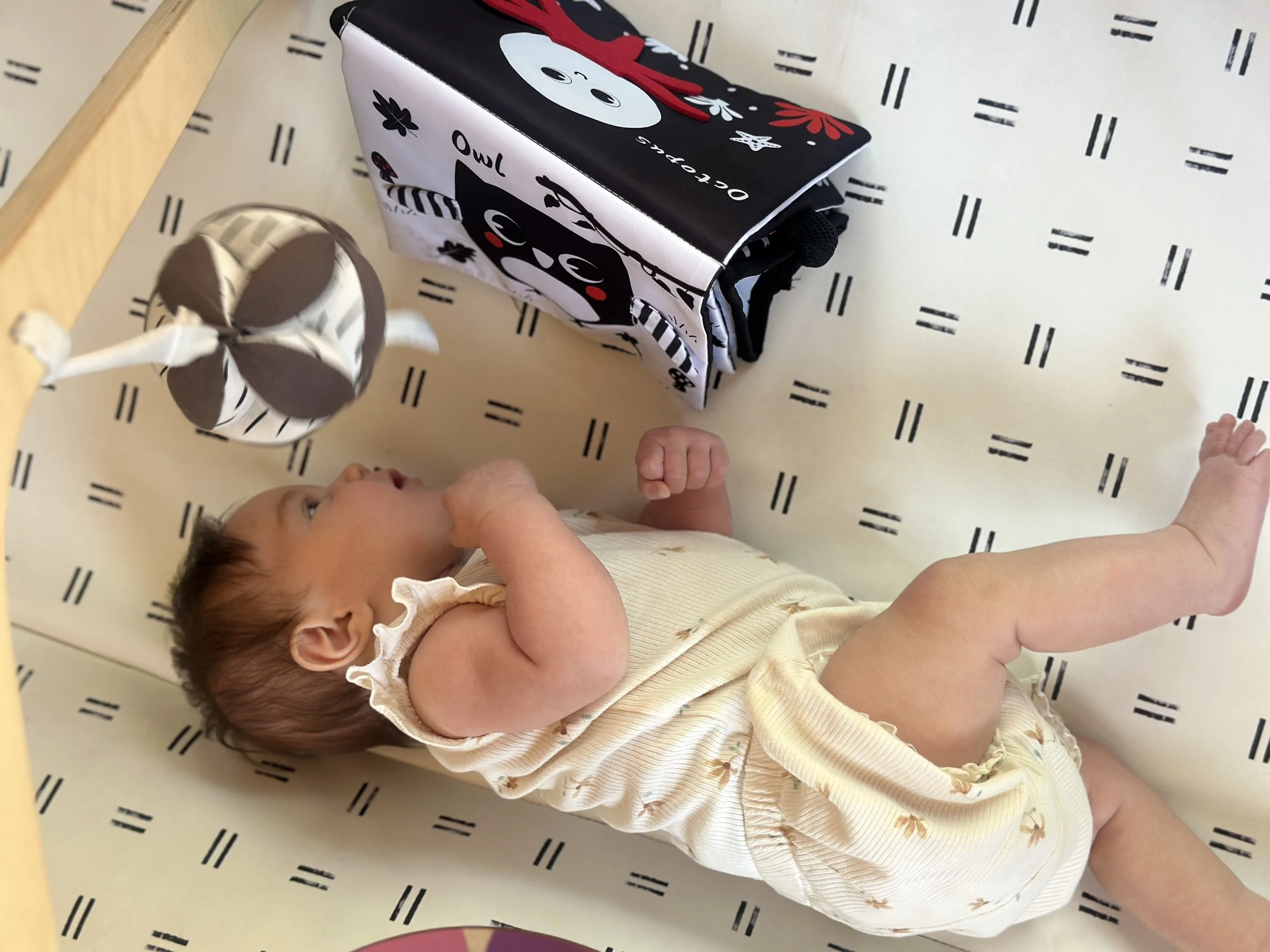
Sidelying play puts your baby right in the transitional space between back and tummy. Reaching for a toy in this position builds weight shifting, core engagement, and the body awareness rolling requires. High-contrast toys work beautifully here — they give babies a reason to reach, look, and stay engaged.
Back Play
Back play is more active than it looks. Open and close your baby’s arms like a hug. Bring their hands to their feet and let them hold on. Place your hands gently under their feet to give them something to push against. Put a toy on their chest or just out of reach so they reach across the midline. All of these build the core strength and body awareness that rolling depends on.
Tummy Time
Supervised awake tummy time builds everything rolling needs: shoulder strength, neck control, core activation, and the weight-shifting experience that precedes rolling. Weave it into every wake window. Place a mirror or toy just to one side to encourage reaching and lateral weight shift. If tummy time is a challenge, building tolerance is part of the work, and a PT can help you get there.
Tummy Time Is Hard: What Your Baby Might Be Telling You →
Limit Container Time
Swings, bouncers, car seats, and infant seats are useful tools for specific purposes. Awake time on the floor is where the weight shifting, reaching, and movement repetitions that build toward rolling happen. The more floor freedom babies have during wake windows, the more opportunity they have to practice.
Rolling Only One Direction
A baby who rolls to one side consistently but struggles to roll the other way is showing you something about what is happening in the body.
Asymmetrical rolling almost always points to underlying asymmetry: torticollis or a head preference that limits rotation to one side, tightness in the trunk or hip on one side that makes it harder to initiate the roll, or a combination of these. The body is finding the easier path, and over time that compensation tends to deepen rather than resolve on its own.
This matters beyond rolling. Asymmetrical rolling can carry forward into asymmetrical crawling, one-sided sitting preferences, and movement patterns that follow the child into toddlerhood. A pediatric PT evaluation can identify what is driving the preference and address it before it becomes more established.
“I started working with Nicole when I noticed my infant would only sleep with his head turned one direction and I had concerns about flattening. Nicole listened to my concerns and observations, and more importantly listened to my son and was able to identify where he had tension affecting his sleep position. After just one session he was able to sleep in a different position, something he had not done in weeks. Nicole made me feel heard and empowered me as a caregiver. She was so gentle and calm with my son and moved at a pace guided by him. I would highly recommend Nicole for any parent who wants the best for their baby.”
— Parent in Denver, head preference and torticollis concerns
When Rolling Is Delayed: Signs Worth a PT Evaluation
There is a wide range of normal, and not every baby who is a little late to roll needs intervention. But some patterns are worth having evaluated:
Not rolling at all by 6 months
Rolling only to one side
Log rolling without true trunk rotation
Not bearing weight on forearms during tummy time by 4 months
Strong and consistent resistance to tummy time
Asymmetrical movement patterns: consistently reaching or kicking more on one side
What commonly contributes to rolling delays:
Torticollis or head preference, which limits the direction rolling can be initiated
Limited tummy time and floor time experience
Trunk or hip tightness that restricts rotation
Prematurity, which affects the timeline for all motor development
Sensory processing differences that make floor play uncomfortable
In Colorado, you do not need a physician referral to start pediatric physical therapy. If something feels off, you do not have to wait for a referral or a failed well visit to reach out. Movevery offers complimentary discovery calls so you can ask questions before committing to anything.
Does It Matter If My Baby Skips Rolling?
Rolling is a developmental process that builds the trunk rotation, body awareness, and motor coordination that crawling, sitting, and so many future skills depend on. When babies spend time in rolling, they are building things that carry forward.
Babies who skip rolling, or who move through it without fully developing trunk rotation, often show the effects in the skills that follow: asymmetrical crawling, difficulty with floor transitions, one-sided reaching preferences, or movement patterns that reflect the rotation still waiting to be developed. Supporting rolling means supporting what comes next.
If your baby seems to be moving past rolling without spending much time in it, a PT evaluation is a useful way to understand what is happening and what would help.
The Movevery Approach
When a family comes to Movevery with rolling concerns, we start with a whole-body evaluation. We ask both whether and how a baby rolls, and what the movement is telling us about what is building underneath.
We assess cervical range of motion, trunk and hip symmetry, weight-bearing patterns, motor planning, sensory responses, and how the baby moves through transitions. Often what looks like a rolling delay on the surface is a reflection of tightness, asymmetry, or a gap in one of the building blocks described above.
Hands-On Bodywork
We use Gillespie-Approach Craniosacral Fascial Therapy (CFT), general manual therapy, and Total Motion Release Tots (TMR Tots). These gentle techniques address the underlying restrictions in the fascial and muscular system that are getting in the way of free, symmetrical movement.
Building Movement Patterns Through Play
Through purposeful play and hands-on movement, we help babies build the trunk rotation, weight shifting, and body awareness that rolling requires. Sessions feel like play because they are play, designed with developmental intention.
Parent Education
You will leave with a clear understanding of what your baby needs and how to weave it into your daily routine. How to roll baby into tummy time. How to set up sidelying play. How to use back play to build core strength. The strategies that make everyday moments into opportunities for your baby to practice and grow.
Related Reading
Tummy Time Is Hard: What Your Baby Might Be Telling You →
Baby Flat Head: Why It Happens, What It Means, and How to Address the Root Cause →
Frequently Asked Questions About Baby Rolling
When do babies typically start rolling?
Tummy-to-back rolling typically develops between 3 and 5 months. Back-to-tummy rolling, which requires more strength and motor planning, usually follows between 4 and 6 months. There is a wide range of normal, and many babies roll earlier or later than these windows. What matters most is that rolling develops symmetrically in both directions, and that the quality of the roll shows true trunk rotation rather than a stiff log roll.
My baby rolls one way but not the other. Is that normal?
Occasional rolling preference is common as babies are learning. But consistent one-sided rolling, where a baby reliably rolls to one side and not the other, is usually a sign of underlying asymmetry worth evaluating. Torticollis, trunk tightness, or hip tightness on one side can all make it harder to initiate a roll in one direction. A pediatric PT can assess what is driving the preference and address it.
How do I help my baby roll?
The most impactful things you can do: roll baby into and out of tummy time rather than placing them directly on their belly, offer side-lying play on both sides, encourage hands-to-feet play and active leg kicking during back time, and maximize floor time in a variety of positions. Reduce time in swings, bouncers, and car seats during awake time, as these limit the freedom of movement that rolling requires.
What is log rolling and why does it matter?
Log rolling is when a baby rotates as one stiff unit, without any rotation through the spine. The head, trunk, and hips all move together rather than in sequence. It can look like rolling, but it does not build the trunk rotation and body dissociation that development needs. Babies who log roll may progress to sitting and crawling without having developed the spinal rotation those skills also depend on. If you notice your baby rolling this way, it is worth a PT evaluation.
Does it matter if my baby skips rolling?
Yes. Rolling is the developmental process that builds trunk rotation, body awareness, and motor coordination, which future skills depend on. Babies who skip rolling often show the effects in the skills that follow: asymmetrical crawling, difficulty with floor transitions, or movement patterns reflecting rotation still waiting to develop. If your baby seems to be moving past rolling without much time in it, a PT evaluation can assess what is happening and support the gaps.
When should I see a pediatric PT about rolling?
Consider reaching out if your baby is not rolling at all by 6 months, rolls only to one side, appears to log roll without trunk rotation, shows strong resistance to tummy time, or has asymmetrical movement patterns, such as consistently reaching or kicking more on one side. In Colorado, no physician referral is needed. Movevery offers complimentary discovery calls if you want to ask questions before scheduling.
How is rolling connected to torticollis?
Torticollis is a shortening or tightness of the sternocleidomastoid muscle on one side of the neck, which limits how far a baby can rotate their head to one side. Since rolling is initiated by head rotation, torticollis directly limits the direction a baby can roll. Babies with torticollis will typically roll more easily toward one side. Treating the torticollis addresses the root of the rolling asymmetry, not just the symptom.
My baby rolled early and now seems to have stopped. Should I worry?
This is common and usually not concerning. Babies often go through periods where a skill temporarily disappears as the nervous system integrates other developments happening at the same time. However, if rolling has disappeared for more than a few weeks, if the return of rolling is only in one direction, or if you notice other changes in movement or tone, it is worth mentioning to your pediatrician or a pediatric PT.
“We had an amazing experience working with Nicole when our son was diagnosed with torticollis and needed support with head reshaping. From the very first visit, Nicole made us feel supported, informed, and confident. She took the time to thoroughly evaluate our son, explain what she was seeing, and create a personalized plan that was easy for us to follow at home. Within just a few weeks, we saw noticeable improvement in his neck mobility and head shape. She was always available between sessions if we had questions. We are so grateful for her patience, knowledge, and truly compassionate care.”
— Parent in Denver, torticollis and motor development concerns
Ready to Get Support?
Rolling is one of the first things your baby’s body has to figure out on its own. If something about how your baby is moving feels worth a closer look, trust that instinct. You know your baby best.
In Colorado, you can reach out to Movevery directly without a physician referral. Schedule a complimentary discovery call and together we will figure out what your baby needs to roll with confidence and ease.
