
What Is Tummy Time and What Is Your Baby Trying to Tell You When It’s Hard?
Tummy time is one of the most talked-about topics in infant development, and one of the most misunderstood. Parents hear “do tummy time” at every check-up but rarely get the full picture: what it’s actually doing for your baby’s body, why some babies genuinely struggle with it, and what that struggle might be communicating. This post covers all of it, from the basics to the deeper signals, so you can support your baby with confidence.
At Movevery Infant and Pediatric Physical Therapy in Denver, Colorado, tummy time is part of every evaluation, every new parent visit, and every routine visit. Tummy time is one of the clearest windows into how a baby’s whole body is functioning. What we see during tummy time tells us a lot. And what parents notice at home matters just as much.
What Is Tummy Time?
Tummy time is any time your baby spends on their stomach while awake and supervised. That’s it. No special mat, no timer, no particular setup required. What it does require is your presence. Tummy time works best when you are right there with your baby, face to face, engaged.
The recommendation to prioritize tummy time comes directly from the Back to Sleep movement. Since the American Academy of Pediatrics launched the safe sleep campaign in 1994, infant deaths from SIDS dropped dramatically. You may have heard the first half of this guidance many times: back to sleep. The second half, tummy to play, is equally important and often given far less airtime.
This shift in sleep safety also brought with it an increase in positional conditions like congenital muscular torticollis and positional plagiocephaly, as babies naturally spent more total time on their backs. Tummy time became the essential counterbalance: active, varied positioning during awake hours that supports the symmetry and strength that back sleeping alone does not provide. It is one of the reasons infant physical therapists talk about tummy time so consistently.
Tummy time is a workout, a sensory experience, and one of the most powerful developmental tools available in the first year of life.
Why Tummy Time Matters: The Foundation for Every Milestone
Every major motor milestone your baby works toward in the first year, including rolling, sitting, crawling, and walking, has its roots in tummy time. Here is what is actually happening when your baby is on their stomach:
Neck and shoulder strength: Lifting the head against gravity strengthens the deep neck flexors, neck extensors, and shoulder girdle. These are the muscles that support every milestone that follows.
Core and trunk development: As your baby lifts their chest and pushes up on their arms, they activate the deep abdominal muscles, spinal muscles, and hip muscles that make sitting and crawling possible.
Flat head prevention: Tummy time gives the back of the skull time off a firm surface, helping prevent positional plagiocephaly, the flat spots that develop when a baby spends too much time in one position.
Sensory development: Tummy time activates three key sensory systems all at once. The proprioceptive system helps your baby sense where their body is in space. It is activated every time they push up against a firm surface and feel the ground beneath them. The vestibular system processes balance and movement, stimulated as your baby lifts, turns, and shifts their weight, similar to the input from rolling or being gently rocked. The tactile system responds to touch and pressure, awakened through the belly, chest, arms, and hands pressing into different surfaces. Together, these sensory inputs are essential for motor planning, coordination, and body awareness.
Visual development: Lifting the head expands the visual field and develops the depth perception that will guide reaching, crawling, and exploring.

A baby-safe mirror during tummy time encourages babies to lift and hold their head while discovering the most motivating face in the room — their own.
Flat spots and torticollis are closely connected to how much varied positioning a baby gets in those early weeks. If you want to understand how tummy time fits into the bigger picture of head shape and neck development, this is a great place to start:
Learn more: Torticollis and Head Shape at Movevery →
For a deeper look at the developmental progression of tummy time by age, from newborn chest rests to pushing up on extended arms, see our full series:
Part 1: Tummy Time Tips for Newborns — Prevent Flat Spots and Torticollis →
Part 2: Tummy Time and Brain Development — How Movement Wires Your Baby’s Brain →
How Much Tummy Time Does My Baby Need?
The American Academy of Pediatrics recommends building toward 30 minutes of total tummy time per day by 3 months of age. That number can sound daunting, but here is the reassuring part: it does not have to happen all at once. Think five one-minute sessions throughout the morning. A few minutes after each diaper change. A short floor stretch during a wakeful window. It adds up quickly, and short, frequent sessions work beautifully for young babies.
Newborn to 1 month: 1 to 3 minutes, 2 to 3 times per day. Chest to chest on a reclined caregiver is perfect and preferred at this stage. Your baby gets your warmth, your smell, and all the motivation they need to lift and look up at your face.
1 to 2 months: 5 to 10 minutes per session, 3 to 4 times per day.
2 to 3 months: 20 to 30 minutes total per day, in whatever increments work for your family.
3 months and beyond: 30 or more minutes per day, in whatever increments fit your family’s day. Many babies this age start to genuinely enjoy tummy time as they gain strength and can push up to look around.
4 to 5 months and beyond: Tummy time starts to become functional as your baby learns to weight shift and can start to engage with toys.
Consistency matters more than perfection. Daily tummy time, even in brief sessions, builds strength cumulatively over the weeks.
How to Do Tummy Time: Positions That Work
Chest to Chest
In the first weeks, lie back at a reclined angle and place your baby tummy down on your chest. Your warmth, smell, and face give your baby every reason to lift their head. This position delivers the same neck and shoulder workout as floor tummy time, and many newborns who fuss on the floor do beautifully here. This is the ideal starting point from day one.
When skin to skin contact is added, with your baby’s bare skin resting against yours, the benefits extend well beyond tummy time. This practice, often called kangaroo care, has a robust body of research behind it. Studies show that skin to skin contact supports heart rate and temperature regulation, lowers cortisol (the stress hormone), promotes breastfeeding and milk production, and strengthens the bond between parent and baby during a critical window of early connection. A landmark Cochrane systematic review found that early skin to skin contact led to significant improvements in breastfeeding rates, infant warmth, and cardiorespiratory stability in both term and preterm newborns.
Research: Early Skin to Skin Contact — Cochrane Systematic Review (Moore et al., 2016) →

Chest-to-chest is the perfect place for a newborn and caregiver to begin tummy time together. It is warm, regulating, and exactly what a newborn's body is designed for.
Floor Tummy Time
Place your baby on a firm, flat surface like a thin blanket or firm play mat on the floor. Dr. Nicole loves the House of Noa and Toki play mats for this. Get down at their eye level, use a baby-safe mirror in front of them, and talk or sing. Your face is your baby’s favorite motivation. Soft surfaces like beds or thick cushions do not provide the right sensory feedback for developing neck muscles.
Shop: House of Noa Play Mats →
Airplane Hold
Hold your baby tummy down along your forearm, their belly resting across your arm and their head at your hand. This position gives your baby a gentle sense of movement and space while their neck and back muscles engage to stabilize. Many babies who find floor tummy time overstimulating at first find the airplane hold calming, and it is a beautiful way to work in tummy time on the move.
Time It Well
The first wake window of the day tends to be the best time for tummy time. Babies are typically most alert and rested before the day’s fatigue builds. Right after a diaper change is another natural window. A hungry or overtired baby will have a harder time with any position, so reading your baby’s cues matters as much as the clock.
Tummy time is important, but it is just one position in a full movement picture. Babies thrive with variety: time on their back (supine), sidelying, tummy time (prone), and upright time all build different strengths and offer different sensory experiences. Think of each position as its own chapter: tummy time is essential, but sidelying, back play, and upright time each add something the story cannot do without. Variety is what makes it a whole book.
Looking for more tips on making tummy time fun, or wondering what to do if your baby has low muscle tone? These posts go deeper:
Part 1: Making Tummy Time Fun — Tips, Positions and Modifications →
Part 3: Tummy Time for Infants With Low Tone — Props, Progressions and Safety →

Floor time with siblings: a reminder that variety in positions matters just as much as tummy time, and that the best movement happens right in the middle of real family life.
When Tummy Time Is Hard: What Your Baby May Be Communicating
Some resistance to tummy time in the first weeks is completely normal. Your baby is working muscles they have never used before, and that takes real effort. Most babies grow to tolerate and enjoy tummy time as they build strength, typically by 2 months.
Consistent, significant distress during tummy time, including arching strongly away, being inconsolable every session, or seeming genuinely uncomfortable rather than simply working hard, is worth paying attention to. Babies communicate through their bodies. When tummy time is persistently very hard, it is often a signal that something in the body needs support.
At Movevery, tummy time difficulty is valuable information and a signal worth following. Here are the most common things it can point to:
Neck Muscle Tightness or Torticollis
Congenital muscular torticollis (CMT), which involves tightness or imbalance in the neck muscles, is one of the most common conditions seen in infants and one of the most direct contributors to tummy time struggles. A baby with torticollis often turns their head comfortably only one direction, collapses to the same side every time in tummy time, or lifts asymmetrically. Left unaddressed, it can affect head shape, rolling, and overall movement patterns through the first year.
Here is what makes this so worth knowing: torticollis responds remarkably well to infant physical therapy, especially when support begins in the first weeks of life. The earlier families ask questions and connect with an infant PT, the faster and more completely babies recover.
The American Physical Therapy Association (APTA) recommends screening for torticollis within the first 2 to 3 days of life. Research shows that PT started before 3 months resolves torticollis in the vast majority of cases. Early identification means earlier support, and earlier support means quicker resolution.
Although torticollis involves tightness in the neck muscles, its effects extend well beyond the neck. Babies often compensate throughout the entire body, with tension showing up in the trunk, shoulders, and hips as well. At Movevery, Dr. Nicole takes a holistic approach, addressing not just the neck but the full body movement patterns that develop around it.
One thing worth noting here: if your baby seems to hold their head up surprisingly well from the very first days of life, this is worth paying attention to for a different reason. A newborn who lifts their head very high very early may be showing tension rather than strength. The neck and spine are meant to develop their natural curves gradually through tummy time, movement, and supported positioning. When a baby holds their head high from the start, it can be a sign that the body is working hard to compensate rather than moving from a place of ease. Tummy time helps the spine develop those natural curves over time. If you are noticing unusually high head holding from the beginning, bodywork can support your baby’s whole-body alignment and comfort from the earliest weeks.
If you notice your baby consistently turning to one side, struggling to lift symmetrically, or showing a head tilt during tummy time, those observations are worth bringing up. You do not need to wait for a scheduled appointment to ask.
Learn more: Tummy Time, Flat Spots and Torticollis — What to Watch For →
Learn more: Why Early Identification Matters — Brain Growth and Early Support →
GI Discomfort and Reflux
Pressure on the abdomen during tummy time can be genuinely uncomfortable for babies with reflux, gas, or constipation. The prone position increases abdominal pressure, which can intensify discomfort in a baby who is already struggling with GI symptoms. Signs that GI discomfort may be contributing include: your baby tolerates elevated tummy time (chest to chest, or on an incline) much better than flat floor tummy time, significant spitting up or arching after feeds, persistent gassiness or fussiness, difficulty stooling or infrequent bowel movements, or discomfort that seems worse right after eating.
When reflux, constipation, or GI discomfort is suspected, tummy time can still continue with the right modifications, because it remains beneficial even then. Waiting 20 to 30 minutes after feeds, using an inclined position, and addressing whole body tension can all make a meaningful difference. At Movevery, Dr. Nicole uses hands-on approaches including manual therapy, Craniosacral Fascial Therapy (CFT), and Total Motion Release (TMR) to support nervous system regulation and whole body comfort. When GI challenges, whole-body tension, or feeding concerns are part of the picture, collaboration with your baby’s pediatrician, an infant chiropractor (who specializes in nervous system regulation and bodywork) and/or an IBCLC ensures the full mother-baby feeding dyad is supported alongside the hands-on PT work.
Oral Ties, Tethered Oral Tissues, and Whole-Body Tension
In Dr. Nicole's experience, the connection between oral ties and whole-body tension is frequently missed in the early months, and it is one she keeps a close eye on at Movevery.
Oral ties, also called tethered oral tissues or TOTs, include tongue ties (ankyloglossia), lip ties, and buccal ties. Parents often hear about these in the context of breastfeeding, but the impact extends far beyond the mouth. Babies with tethered oral tissues can carry tension throughout the entire body, from the jaw all the way down through the neck, shoulders, trunk, hips, and toes.
This happens because of the fascia, a continuous web of connective tissue that wraps around and through every muscle, organ, and structure in the body. Think of fascia like the white membrane on the inside of an orange peel: it connects every segment to every other segment, and a restriction in one area creates tension that travels throughout the whole. In babies with tethered oral tissues, that restriction at the tongue or lip level can create a chain of tightness that runs literally from the tongue to the toes.
For these babies, tummy time can feel difficult because their whole body is working against this underlying tension, making it hard to push up, turn their head freely, or relax into the position. Common signs that tethered oral tissues may be contributing to tummy time difficulty include clicking or popping sounds during feeds, difficulty latching or poor milk transfer on one side, excessive gassiness from swallowing air, arching during or after feeds, and a baby who seems tight or uncomfortable during general handling.
It is important to note that infant physical therapists do not diagnose oral ties. What we do is assess how your baby is functioning and moving, and make appropriate referrals. Some of the things we look out for: Is there clicking or popping during feeds? Is latching difficult or one-sided? Is feeding painful for mom? Is the baby gassy or taking in excess air? Are they consistently tight or uncomfortable in general handling or during tummy time? These functional signs help us identify when a referral is warranted and guide our hands-on support. Dr. Nicole always loves to work alongside a skilled IBCLC, infant chiropractor, and/or airway-focused dentist, because the body tension and the feeding relationship are not separate issues. They are deeply interconnected, and the whole mother-baby dyad needs to be supported together.
Addressing tethered oral tissues typically involves a collaborative care team including some combination of the following: an airway-focused dentist for evaluation and any procedure, an IBCLC to ensure the full mother-baby feeding dyad is supported, and bodywork providers trained in whole-body tension release such as infant physical therapists, pediatric chiropractors, or pediatric occupational therapists for oral motor and feeding support. Dr. Nicole uses a whole body approach at Movevery that directly addresses the fascial and muscular tension that can accompany tethered oral tissues. With the right collaborative support in place, tummy time, feeding, and overall movement can feel significantly easier for babies and families."
Dr. Nicole works alongside a trusted team of local providers for oral tie and feeding support:
Dr. Dani — Balanced Chiro and Rehab (home visits available) →
Dr. Jaimy and Dr. Brittany — Belly Bliss (chiropractic + IBCLC, clinic appointments) →
Brittani — The Milk Academy, IBCLC →
Dr. Liz Turner — Untethered Airway Health Center (airway dentist) →
Low Muscle Tone (Hypotonia)
Some babies feel unusually soft or floppy when held, fatigue quickly during tummy time, or are slow to build head control. This can be a sign of hypotonia, or low muscle tone. Tummy time is especially valuable for these babies, and it works best when approached with supported positions and gradual progressions.
Learn more: Tummy Time for Infants With Low Tone →
The most important thing to know: tummy time difficulty is valuable information and a signal that something in your baby’s body may need support. When you know what to look for, you can connect with the right care early, and early support changes outcomes.
Tummy Time vs. Container Time: Understanding the Difference
In the first months of life, babies spend a lot of time in what are often called containers: car seats, bouncers, swings, rockers, and infant seats. These tools have a real place in family life, and no one is suggesting you give them up. But understanding the difference between container time and active floor time helps you make the most of your baby’s awake windows.
Containers keep your baby in a fixed, semi-reclined position. The muscles of the neck, trunk, and shoulders do not need to work actively here. Floor time is where active movement and strength building happen. Whether your baby is on their back, their side, or their tummy, floor play gives the body something to push against, explore, and respond to.
Baby carriers are in a category of their own. When worn with good positioning, carriers offer some neck and trunk engagement, body warmth, and the regulating effect of being close to a caregiver. They are an active option in a way that bouncers and swings are not, though they still do not replace floor tummy time.
Learn more: Baby Carriers and Positioning — Hip Dysplasia Institute →
A simple guideline: use container time as needed throughout the day, but aim to keep individual stretches to at most 10 to 15 minutes, then follow with floor time. As a mom of three, I completely understand those moments when you need to set your baby down safely to get something done in the same room. That is exactly what containers are for. But floor time is always the better choice when you can make it happen: back play, side play, tummy time, and being held all give your baby the full range of movement and sensory input their developing body needs.
If your family does rely on a seat for supported upright time, the Upseat is one option we recommend. It is designed specifically to encourage more active trunk and hip positioning compared to standard bouncers. (For a 10% discount, use our code: theupseat.com/MOVEVERYPT10)
And the one rule that never changes: tummy time is for awake, supervised moments only. Stomach sleeping is not safe until your baby can roll independently. Back to sleep, tummy to play.
When to Reach Out to an Infant Physical Therapist
You do not need to wait until something is clearly wrong to reach out to an infant PT. Many of the families we work with at Movevery come in because something feels off, or because they want to understand what they are seeing, and that is exactly the right instinct.
Reach out if you notice any of the following:
Your baby consistently turns their head to one side or shows a strong preference for looking one direction (Ideally before 2 months of age)
You notice a flat spot developing on one side of the head
Your baby shows significant resistance to tummy time beyond 2 months of age
Your baby is lifting their head inconsistently or is unable to lift by 3 months
Your baby seems unusually stiff or floppy during tummy time or general handling
Tummy time is consistently worse on a flat surface than on an incline or on your chest
Feeding challenges are showing up alongside tummy time difficulty
Something feels off and your instinct is telling you to ask
In Colorado, you have direct access to physical therapy and no physician referral is needed. At Movevery, we offer complimentary discovery calls so you can share what you are seeing and we can decide together whether an evaluation makes sense.
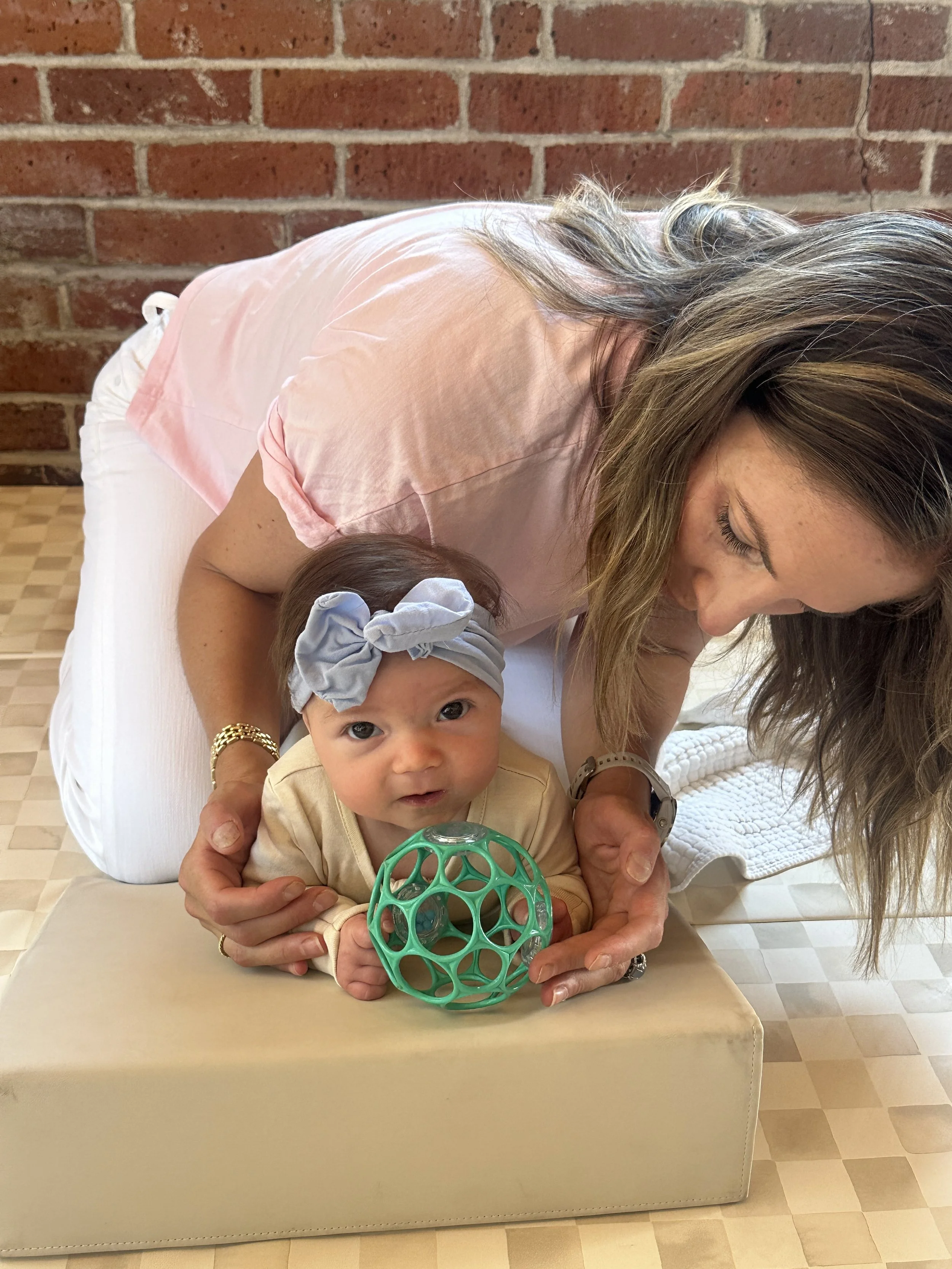
Supported tummy time using a foam wedge at Movevery — a great starting point for babies who struggle on flat surfaces.
Explore the Full Tummy Time Series
This post is your foundational guide. For deeper dives into specific topics, the full series goes further:
Part 1: Tummy Time Tips for Newborns — Prevent Flat Spots and Torticollis →
Part 2: Tummy Time and Brain Development — Early Support for Healthy Growth →
Part 3: Tummy Time for Infants With Low Tone — Props, Progressions and Safety →
Frequently Asked Questions About Tummy Time
What is tummy time and why is it important?
Tummy time is supervised, awake time on your baby’s stomach. It builds the neck, shoulder, and core strength every major motor milestone depends on, helps prevent flat spots on the head (positional plagiocephaly), and provides rich sensory input through the proprioceptive, vestibular, and tactile systems. The American Academy of Pediatrics recommends starting from birth.
My baby screams during tummy time. What could be causing it?
Consistent distress during tummy time can signal neck tightness or torticollis, GI discomfort or reflux, tethered oral tissues (oral ties) causing whole body tension, or low muscle tone. An infant PT can help identify what is going on and create a plan that makes tummy time manageable and even enjoyable.
Can oral ties or tethered oral tissues make tummy time harder?
Yes, and this connection is more common than most parents realize. Oral ties (also called tethered oral tissues or TOTs, including tongue ties, lip ties, and buccal ties) can create tension that travels through the fascia, the connective tissue that runs continuously from the mouth through the neck, shoulders, trunk, hips, and all the way to the toes. When the fascia is restricted at the oral level, babies can carry whole body tension that makes tummy time genuinely uncomfortable. We always look at and think about function! If your baby also shows feeding challenges, clicking during feeds, gassiness, or difficulty latching alongside tummy time difficulty, tethered oral tissues are worth exploring with an IBCLC (International Board Certified Lactation Consultant) and/or an airway-focused dentist or specialized ENT.
Does reflux mean my baby should avoid tummy time?
Tummy time can absolutely and beneficially continue when a baby has reflux and may simply need to be modified. Waiting 20 to 30 minutes after a feed, using an inclined position like chest to chest, and addressing body-wide tension can make tummy time significantly more comfortable. An infant PT can help you find an approach tailored to your baby’s needs.
How early should I screen for torticollis?
The American Physical Therapy Association recommends screening for torticollis within the first 2 to 3 days of life. The earlier torticollis is identified and treated, the faster and more completely babies recover. PT begun before 3 months resolves torticollis in the vast majority of cases.
Do I need a referral to see a infant PT in Colorado?
Colorado has direct access to physical therapy, meaning you can schedule an infant PT evaluation without a physician referral. If something feels off with your baby’s tummy time, head turning, or overall movement, you can reach out directly to Movevery for a complimentary discovery call.
What is the difference between tummy time difficulty from low tone versus torticollis?
Torticollis tends to show up as asymmetry. Your baby may consistently turn their head one direction, lifts more easily on one side, or has a visible head tilt. Low tone tends to show up more globally. These babies often feel unusually soft or floppy overall, fatigues quickly, and struggles to hold any position for long. Both respond well to early infant PT, and both can be present together. A PT evaluation can help clarify what is driving the difficulty and what approach will help most.
Tummy Time Is a Conversation
Every lift, wiggle, and push your baby makes during tummy time is communication. They are building strength and telling you something about how their body feels. When it goes smoothly, that is wonderful. When it is hard, that is information, and information leads to the right support.
You do not need to figure it out alone. Whether your baby is thriving in tummy time or struggling with it every single day, we are here to help you understand what you are seeing and move forward with confidence.
Get on the floor, get face to face, and let your baby show you what they are capable of. We’ll be right there with you.
A note on links: some products mentioned in this post are affiliate or referral links, including Toki play mats and the Upseat. If you purchase through these links, I may earn a small commission — at no extra cost to you. I only share things I would recommend to the families I work with.
