
Infant Torticollis: Signs, Why It Affects the Whole Body, and What Tear-Free Treatment Really Looks Like
If you have noticed your baby consistently looking to one side, have been told they have torticollis, or something simply feels off in how your baby holds their head, you are in the right place. Congenital muscular torticollis is one of the most common conditions seen in newborns, one of the most treatable, and one that responds best when support begins early.
At Movevery Infant and Pediatric Physical Therapy in Denver, Colorado, torticollis is one of the conditions we see and work with most. We take a holistic, tear-free approach that looks at the whole baby, not just the neck. This post walks you through everything you need to know, from the first signs to watch for to what treatment actually looks like.
What Is Congenital Muscular Torticollis?
Congenital muscular torticollis (CMT) is defined by shortening of the sternocleidomastoid (SCM), a muscle that runs from behind the ear down to the collarbone on each side of the neck. By definition, CMT involves true shortening of this muscle, not just temporary tightness. This shortening causes a baby’s head to tilt toward the affected side and rotate toward the opposite shoulder. CMT is present at birth or develops in the early weeks of life, and it is one of the most common musculoskeletal conditions seen in newborns.
When the SCM is shortened on one side, it pulls the head into a characteristic posture: ear tilting toward the shoulder on the involved side, with the chin rotating toward the opposite shoulder. Some babies also develop a small, firm thickening in the SCM that may be felt in the first weeks of life.
CMT can develop from positioning in the womb, a difficult delivery, or early postnatal head positioning. The head tilt is usually the first thing parents and providers notice, but as we will explore, the effects of torticollis extend far beyond the neck.
Torticollis Goes Beyond the Neck
While the head tilt is the most visible sign, the tightness that underlies torticollis often extends throughout the entire body. This is something parents and many providers do not always hear about, and it is central to how we approach treatment at Movevery.
This happens because of the fascia, the continuous web of connective tissue that runs through every muscle, organ, and structure in the body. Think of fascia like the white membrane on the inside of an orange peel: it connects every segment to every other segment, and a restriction in one area creates tension that travels throughout the whole. When there is shortening and restriction on one side of the neck, that unbalanced tension can travel down through the trunk, affecting shoulder alignment, hip position, spinal symmetry, and even digestive function.
It is worth noting that not all muscle tension is a problem. Some tension is completely normal and essential for movement and stability. What matters in torticollis is the imbalance: restriction on one side that pulls the body out of symmetry and affects how your baby grows, moves, and feels.
Common ways this whole-body unbalanced tension shows up in babies with torticollis:
A C-shaped curvature of the spine, visible when baby lies on their back or tummy
Asymmetry in the shoulders or hips
Difficulty with tummy time, often collapsing to the same side every time
Preference for one breast or one bottle position during feeding
Gassiness and digestive discomfort from unbalanced body tension
Asymmetrical rolling, reaching, or movement patterns

This baby, Dr. Nicole’s son, shows a classic head preference with chin rotation to one side and a C-shaped curve through the spine — two hallmark signs of congenital muscular torticollis.
Signs and Red Flags: A Parent Checklist
One of the most valuable things a parent can do is know what to watch for. The earlier torticollis is identified, the faster and more completely babies tend to respond to treatment.
Signs that may indicate torticollis or a head turning preference worth addressing:
Head tilted to one side, with the ear moving toward the shoulder
Chin consistently rotated toward the opposite shoulder
Strong preference to look in only one direction during feeding, play, or sleep
Difficulty or fussiness with nursing or bottle feeding on one side
A flat spot developing on one side of the back or side of the head
A C-shaped appearance of the spine when baby is lying on their back
Asymmetrical tummy time: collapsing to one side, struggling to lift on the other
Reaching or rolling more easily to one side
A firm lump or thickening felt on one side of the neck in the early weeks
General fussiness in the car seat or other reclined positions
Seeing one sign on this list does not automatically mean torticollis is present. These are patterns worth paying attention to and worth discussing with your provider or a pediatric PT. A consistent head preference in a newborn, even without other signs, is worth a conversation. The 2024 Clinical Practice Guidelines for Congenital Muscular Torticollis from the American Physical Therapy Association recommend that all newborns be screened for torticollis within the first 2 to 3 days of life, precisely because early identification makes such a significant difference.
“I started working with Nicole when I noticed my infant would only sleep with his head turned one direction and I had concerns about flattening. Nicole listened to my concerns and observations, and more importantly listened to my son and was able to identify where he had tension affecting his sleep position. After just one session he was able to sleep in a different position, something he had not done in weeks. Nicole made me feel heard and empowered me as a caregiver. She was so gentle and calm with my son and moved at a pace guided by him. I would highly recommend Nicole for any parent who wants the best for their baby.”
— Amy and baby
The Feeding Connection
One of the most underappreciated connections in early infant care is the link between torticollis and feeding. Many parents hear about torticollis in the context of head shape or movement, but the neck tightness that defines this condition can have a direct and significant impact on how a baby nurses or takes a bottle.
When the SCM is shortened on one side, the jaw, for example, does not sit or move symmetrically. This can affect how a baby latches, transfers milk, and coordinates the suck-swallow-breathe pattern that feeding depends on. Research has established a clear connection between congenital muscular torticollis, jaw asymmetry, and feeding patterns. Lactation consultants are increasingly encouraged to refer infants with persistent feeding challenges for a pediatric PT evaluation, not to address feeding directly, but to evaluate and treat the underlying torticollis and body tension that may be contributing.
Common signs that torticollis may be affecting feeding:
Difficulty latching or an inconsistent, shallow latch
A strong preference for one breast or one bottle position
Clicking or popping sounds during feeds
Poor milk transfer or slow weight gain
Feeding pain for the nursing parent
Excessive gassiness from air swallowing during feeds
It is also worth noting that tethered oral tissues (i.e. tongue tie or lip tie) frequently co-exist with torticollis. The fascial system connects the tongue to the hyoid bone and into the cervical spine, meaning restriction in one area can influence the other. We do not diagnose oral ties, but we do assess and address the whole-body tension patterns that often accompany them.
At Movevery, pediatric physical therapy focuses on the whole body: the musculoskeletal root of the torticollis, the postural asymmetry, and the restriction patterns that travel through the trunk and jaw. Addressing those roots often leads to meaningful improvements in how comfortably a baby nurses or takes a bottle. Feeding and oral motor difficulties are best supported by specialists in those areas, and Dr. Nicole loves to collaborate with a skilled IBCLC and/or a pediatric occupational therapist, depending on your baby’s age and specific needs. That kind of team approach typically leads to the best outcomes for the whole family.
The Flat Head Connection
Torticollis and positional plagiocephaly (flat head syndrome) are closely connected, and they frequently appear together. Research suggests they co-occur in a significant percentage of cases, with some studies reporting rates as high as 90 percent depending on definitions used.
Here is why: when a baby consistently holds their head turned in one direction because of neck tightness, that area of the skull receives more pressure during sleep and rest. The skull is still soft and malleable in infancy, and over time this sustained pressure can cause flattening on that side.
The relationship also runs in the other direction. A developing flat spot can change the shape of the head in ways that limit how comfortably a baby turns, which reinforces the head preference and the neck tightness. This bidirectional cycle is exactly why addressing torticollis early, before flat spots develop or worsen, matters so much.
Here is something that does not always make it into the conversation: a flat head is not the problem itself. It is a symptom of underlying movement dysfunction, most often driven by torticollis, restricted range of motion, or limited variety in how a baby actively moves and bears weight. If the focus is only on reshaping the skull, whether through repositioning strategies alone or a cranial helmet, without addressing the root cause, the cycle often continues.
A physical therapy evaluation is designed to identify exactly why the head flattening is happening in the first place. Is there neck shortening that limits how the baby turns? Is trunk or hip tightness reducing how freely they shift and load? Understanding the source is what makes the difference between chasing a symptom and actually resolving it.
When the root cause is addressed, results tend to come faster and more completely. Head shape improves alongside movement milestones and overall comfort, because these things are all connected. Families who access that whole-body support early spend less time stressed, less time searching for answers, and more time simply enjoying their baby.
When a cranial remodeling helmet is recommended, physical therapy is a powerful complement to that process, and Dr. Nicole collaborates closely with orthotists in those cases. The helmet addresses the skull shape; physical therapy addresses the movement dysfunction underneath it. Together, they create the most complete picture of support. A helmet alone, without addressing why the flattening happened, may limit how much progress a family sees. Physical therapy alongside a helmet helps the movement patterns that allow the skull to respond fully to the reshaping process. A full guide to positional plagiocephaly, flat head syndrome, and cranial helmets is coming soon from Movevery.
Learn more: Flat Heads in Babies and Why Early Pediatric PT Matters →
Why "Wait and See" Is Not Always the Right Answer
Many parents are told that torticollis will resolve on its own, or are given a few neck stretches to try at home. While some mild cases do improve naturally, many babies continue to develop compensation patterns throughout the body that affect their comfort, head shape, and motor development well into the first year.
The 2024 Clinical Practice Guidelines for Congenital Muscular Torticollis from the American Physical Therapy Association are clear: all newborns should be screened for torticollis within the first 2 to 3 days of life, and physical therapy is recommended as the first-line treatment. The guidelines emphasize that early identification leads to earlier support, and earlier support leads to significantly better outcomes.
The timing of treatment matters:
PT started before 1 month: treatment typically lasts 6 to 8 weeks with excellent outcomes
PT started between 1 and 3 months: treatment typically lasts 3 to 6 months
PT started after 6 months: treatment can take 9 to 10 months or longer, with a smaller percentage of babies achieving full resolution
This is not meant to alarm parents who are just finding out about torticollis in an older baby. Support at any age is absolutely worth pursuing. But it is a strong reason to act on your instincts early rather than waiting for the next scheduled appointment if you are noticing signs.
“Nicole was so wonderful to work with. We saw her for our one-month-old’s torticollis. She got us in for an evaluation within days of reaching out, even during the busy holiday season, and came to our home, which was so appreciated with a newborn. We noticed a big improvement in his torticollis and his ability to turn toward his non-preferred side within several days. She is so attentive and really understands how to work with a newborn. We really appreciated Nicole’s expertise and kindness and would highly recommend her to anyone looking for pediatric physical therapy.”
— Shara & baby
The Movevery Approach: Tear-Free and Whole-Body
At Movevery, we believe treating torticollis should not feel like a battle. Historically, torticollis has been treated with passive neck stretches as the primary tool, followed by functional activities. These approaches can produce results, but the heavy emphasis on stretching can be uncomfortable and is often not well tolerated by babies or their parents. They also tend to center on the neck, without fully addressing the deeper fascial restriction and whole-body compensation that so often travel with the condition.
Our approach is different. It is gentle, whole-body, and tear-free. Every evaluation looks at far more than the neck, assessing posture, head shape, shoulder and hip symmetry, digestive patterns, and how your baby moves, sleeps, and interacts with the world. That whole-body lens shapes everything we do from the first session forward.
Hands-On Bodywork: CFT, Manual Therapy, and TMR Tots
The hands-on approaches Dr. Nicole uses at Movevery for torticollis include Gillespie-Approach Craniosacral Fascial Therapy (CFT), general manual therapy, and TMR Tots (Total Motion Release for Tots).
Gillespie-Approach CFT is an exceptionally gentle technique that works with the craniosacral fascial system: the interconnected network of the brain, spinal cord, and the fascial web extending throughout the entire body. Developed by Dr. Barry Gillespie, it uses very light touch to follow the natural motion and rhythm of the body, finding and releasing areas of restriction contributing to the torticollis pattern. Because CFT works with the whole fascial body rather than targeting one muscle in isolation, it is especially well suited for infants, and for conditions like torticollis where restriction patterns extend well beyond the neck.
General manual therapy techniques complement the CFT work, addressing soft tissue restrictions and supporting joint mobility throughout the body.
TMR Tots is a modified positional release approach that was developed initially for children with neurological and motor challenges and has since become one of the most effective and parent-loved tools for treating torticollis, because it gets results without tears. Rather than focusing solely on the neck, TMR Tots uses a systematic evaluation to identify areas of restricted mobility throughout the entire body, including compensating restrictions in the trunk, hips, and lower extremities that are connected to the neck tilt and rotation. These compensation patterns can affect how a baby rolls, sits, and develops motor skills over time, so addressing the full picture matters.
Treatment with TMR Tots is precise and purposeful: find the root restrictions, treat them specifically, and build from there. Therapeutic activities are matched to what motivates each baby, so sessions feel like play. Parents and caregivers are empowered with strategies they can weave into daily routines at home, turning everyday moments into opportunities for the body to find new patterns of ease and symmetry.
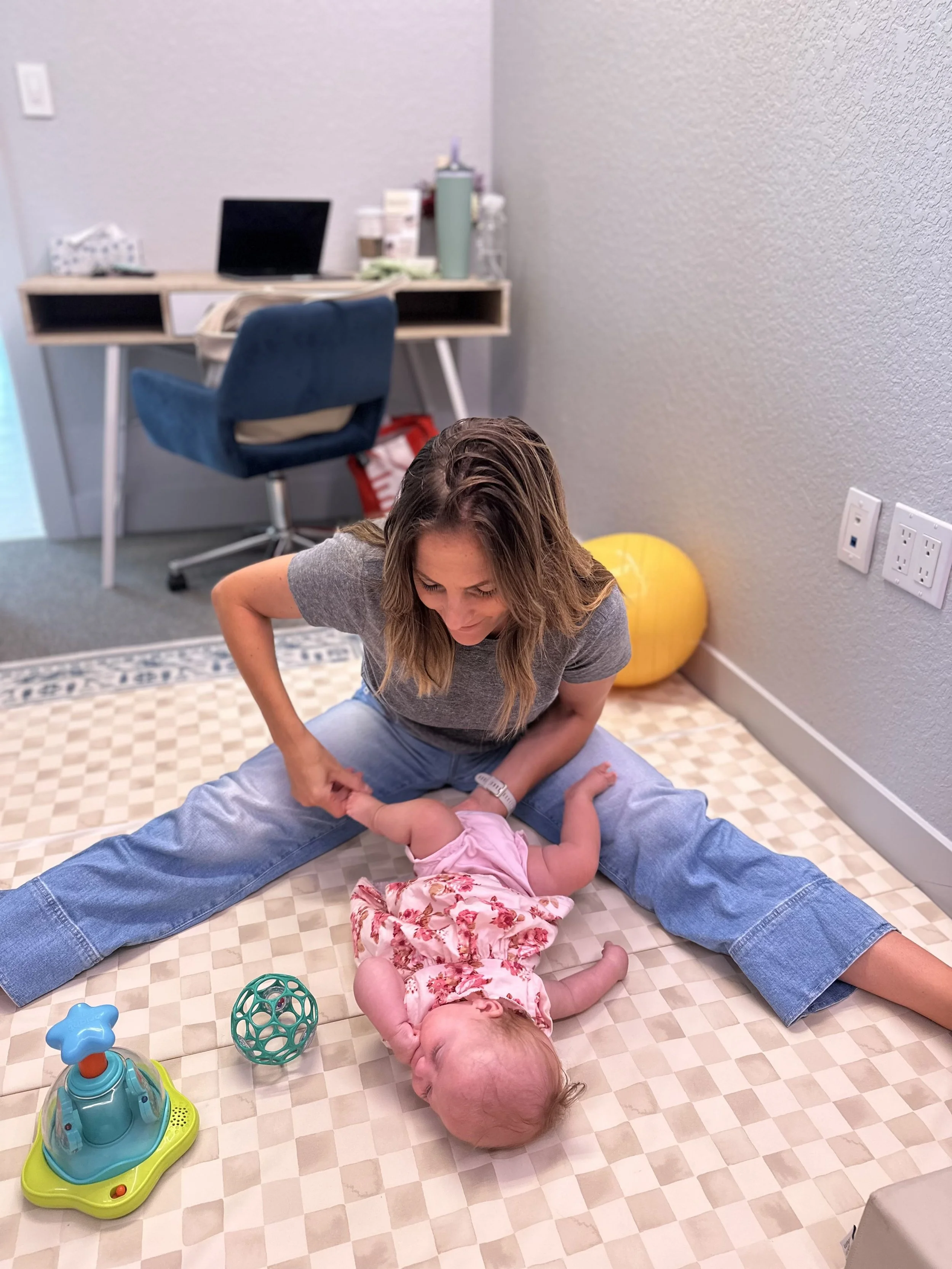
Gentle, whole-body hands-on work to release restriction and support alignment — no tears, just the body finding its way back to ease.
Neuromuscular Re-Education and Developmental Movement
Releasing restriction is one part of the picture. Teaching the body new movement patterns — what clinicians call neuromuscular re-education — is the other. Through purposeful play, Dr. Nicole helps babies develop and improve movement, coordination, balance, and motor planning. This supports the foundation for tummy time, rolling, crawling, sitting, and beyond, all in a way that feels fun and empowering for both baby and parent.
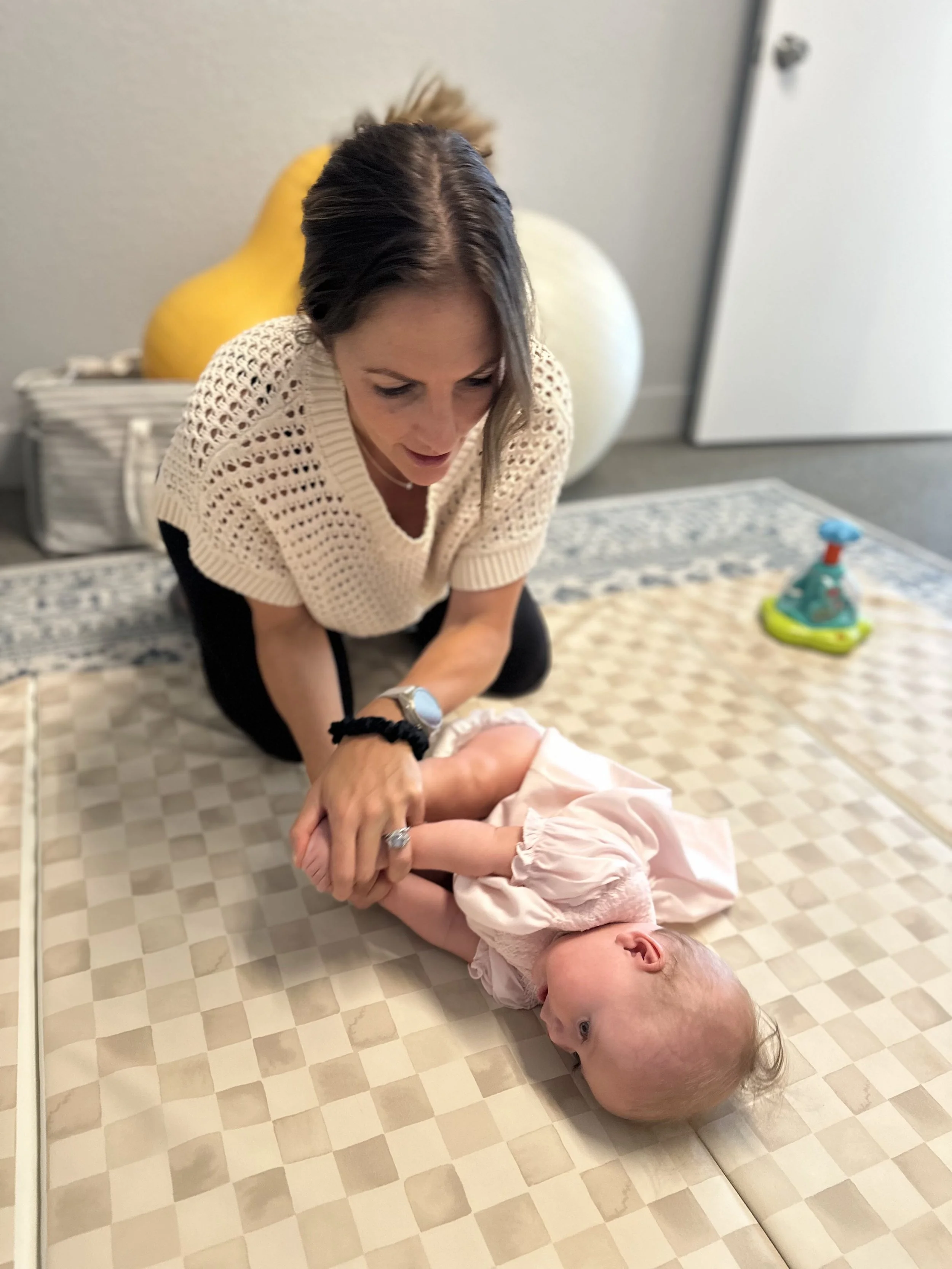
Dr. Nicole uses purposeful movement to build symmetrical strength and motor patterns from the ground up.
Parent Education and Support
Parents are full partners in the Movevery approach. Dr. Nicole guides you through how to support your baby’s body during holding, feeding, play, and daily routines. You will learn how to use positioning to encourage symmetry and strength, how to maximize tummy time, and how to use containers in ways that best support your baby’s developing body when you need them, because parents genuinely need five minutes hands-free, and that is completely real. Every session is designed so that both you and your baby leave feeling more at ease, more connected, and more confident in what is possible.
What to Expect at Movevery
The first visit is a comprehensive evaluation. Dr. Nicole will assess your baby’s full cervical range of motion, overall posture and alignment, functional movement patterns, and related concerns like head shape changes. She will also take time to listen to your feeding observations and any questions or worries on your mind, because you are the expert on your baby, and that information helps shape the whole picture. You will leave with a clear understanding of what is going on and a plan tailored to your baby.
Sessions typically happen weekly or biweekly depending on your baby's age and presentation. There is no set “protocol”. Care is truly individualized and recommendations are made based on your child. Home strategies are woven into every session so that your daily life supports the work being done.
Most families begin to notice meaningful changes within the first few sessions. The timeline to full resolution depends on when support begins, as described above, but the goal at every stage is the same: a baby who moves freely, comfortably, and symmetrically, and a parent who feels equipped and supported.
In Colorado, you do not need a physician referral to start pediatric physical therapy. You can reach out to Movevery directly and schedule a complimentary discovery call to ask questions and find out if we are the right fit for your family.
“We had an amazing experience working with Nicole when our son was diagnosed with torticollis and needed support with head reshaping. From the very first visit, Nicole made us feel supported, informed, and confident. She took the time to thoroughly evaluate our son, explain what she was seeing, and create a personalized plan that was easy for us to follow at home. Within just a few weeks, we saw noticeable improvement in his neck mobility and head shape. She was always available between sessions if we had questions. We are so grateful for her patience, knowledge, and truly compassionate care.”
— Sandy and baby
Related Reading
If your baby is also struggling with tummy time, flat spots, or you want to understand the full developmental picture, these posts are a great place to start:
What Is Tummy Time and What Is Your Baby Trying to Tell You When It's Hard? →
Flat Heads in Babies: Why Early Pediatric Physical Therapy Matters →
Infant Development Guide (0–3 Months): Bonding, Early Skills and Milestones →
Frequently Asked Questions About Infant Torticollis
Can torticollis resolve on its own?
Some mild cases of torticollis improve with time and repositioning strategies. However, many babies continue to develop compensation patterns throughout the body that affect their development and head shape if the underlying restriction is not addressed. The American Physical Therapy Association (APTA) recommends physical therapy as the first-line treatment, and early intervention consistently produces the best outcomes.
How do I know if my baby has torticollis or just a head preference?
A head preference means your baby looks one direction more often but can comfortably turn to the other side when encouraged. Torticollis involves actual restriction in range of motion, where turning one direction is noticeably harder or more limited. It is also worth knowing that a head preference can sometimes originate from tightness in the trunk or hips, even when neck range of motion appears full. Either way, a pediatric PT evaluation can identify where the restriction is coming from and make sure your baby is building strength and mobility symmetrically.
At what age should I seek help for torticollis?
As early as possible. The APTA 2024 Clinical Practice Guidelines recommend screening within the first 2 to 3 days of life. If your baby was not screened and you are noticing signs at any age, reach out now. Treatment is effective at every age, but earlier means faster resolution.
Does torticollis affect breastfeeding?
Yes, it can. Neck tightness affects jaw symmetry and latch mechanics, making it harder for babies to nurse comfortably on one or both sides. Working with a collaborative care team, including a pediatric PT, a skilled IBCLC, and when appropriate an infant chiropractor or occupational therapist, typically produces the best outcomes for the whole mother-baby dyad.
Will my baby need neck stretches at home?
At Movevery, our approach is primarily hands-on bodywork and functional movement rather than passive stretching. We may guide you through specific handling and positioning strategies for home, but the focus is always on what feels good and sustainable for your family, not exercises that feel like a battle.
Can torticollis cause a flat head?
Yes. When a baby consistently holds their head to one side due to neck tightness, that area of the skull receives more pressure over time, which can lead to flattening. Addressing torticollis early is one of the most effective ways to prevent or reduce flat spots.
Is torticollis painful for babies?
Babies with torticollis are not always in obvious pain, but they may be uncomfortable in certain positions, fussier during feeding or tummy time, or resistant to having their head turned. Many have simply adapted to the restriction and do not know any other way of being. Treatment helps restore ease and comfort.
Is there a difference between torticollis and "wry neck"?
Congenital muscular torticollis (CMT) is present at birth or develops in early infancy due to muscle tightness or shortening. It is different from acute or acquired torticollis, which can occur in older children from illness, trauma, or a sudden movement. CMT in infants is what pediatric PTs like Dr. Nicole specialize in treating.
“Nicole is everything. The most knowledgeable, kind, patient baby PT out there. We used her for my son, who was a newborn at the time, because he had tight hips and slight torticollis. She would come to our house to work with him while teaching me ways to best support his growth and development. She sent comprehensive emails afterward to recap and was always available for a quick call or text when we had questions. Our son is now eight months old and crawling. He is thriving, and I am sure it is because of Movevery. You cannot go wrong with Nicole for infant physical therapy.”
— Pam and baby
Ready to Get Support?
Torticollis is highly treatable, especially with early intervention. If you are noticing signs of a head preference, flat spots, or asymmetrical movement, trust your instincts.
In Colorado, you can self-refer to physical therapy. You do not need a pediatrician's referral to get started. Reach out to Movevery to schedule a complimentary discovery call, and together we will help your baby move freely, comfortably, and with confidence.
