
Baby Flat Head: Why It Happens, What It Means, and How to Address the Root Cause
If someone has pointed out that your baby has a flat spot, or you have noticed it yourself, you are not alone. Positional plagiocephaly is a common concern that brings families to a pediatric PT. The good news: it is addressable, and the earlier you start, the more options you have and the better the outcomes tend to be.
At Movevery Infant and Pediatric Physical Therapy in Denver, Colorado, flat head concerns are some of the most common reasons families reach out to us. We approach flat head not as a cosmetic issue, but as a symptom of underlying movement dysfunction. This post walks you through what causes flat spots in babies, why the root cause matters more than the shape, what your treatment options look like, and when physical therapy combined with a cranial helmet creates the most complete picture of support.
What Is Positional Plagiocephaly?
Positional plagiocephaly is a flat spot on one side of the back of the skull that develops from sustained pressure on that area. The infant skull is intentionally soft and malleable in early life, designed to allow the rapid brain growth that happens in the first year. That softness also means skull shape can be influenced by position and pressure over time.
You might also hear the term brachycephaly, which is different. Brachycephaly is flattening across the entire back of the skull, resulting in a wider, shorter head shape. Both are common and both develop from sustained positioning, though the pattern, location, and treatment approach can differ.
It is important to distinguish positional plagiocephaly from craniosynostosis, which is a different condition where the sutures of the skull fuse prematurely. Craniosynostosis requires different evaluation and treatment. If there is any concern about whether a flat spot is positional or structural, a pediatric PT or pediatrician can help clarify.
The “Back to Sleep, Tummy to Play” campaign of the 1990s, introduced to reduce SIDS risk, made positional variety and supervised awake tummy time more important than ever. It is a guideline that saves lives, and one that changed how we think about supporting healthy head shape development.

Back to Sleep is a life-saving guideline. It also means that the time babies spend awake and supervised matters more than ever. Tummy time, positional variety, and early attention to head preferences are how we balance safe sleep with healthy development.
How Does Flat Head Develop?
Positional plagiocephaly develops when one area of the baby’s skull bears sustained pressure over time. Several things can lead to this:
Torticollis and Head Preference
This is the single most common cause. When a baby has torticollis (neck shortening) or a strong preference to turn their head one direction, they consistently rest that same spot of their skull against sleep surfaces. Over weeks and months, that sustained pressure flattens the bone. Research consistently shows that torticollis and flat head frequently co-occur, making torticollis one of the most critical things to evaluate when a flat spot is present.
Limited Positional Variety
Even without torticollis, babies who spend extended time on their backs without frequent position changes, adequate tummy time, or side-lying periods can develop flattening. The back of the skull bears more pressure in this position.
In Utero Positioning
Babies who were constrained in the womb for any number of reasons, for example a multiple pregnancy, low amniotic fluid, or breech positioning, may emerge with head shape changes already present. These sometimes resolve naturally over the first weeks, but sometimes they persist and worsen if not addressed.
Birth Factors
Vacuum extraction, forceps delivery, or prolonged labor can temporarily affect head shape. Most of these changes resolve naturally, but if they combine with torticollis or container use afterward, they can become more established.
Container Use
Car seats, bouncers, swings, and other containers keep a baby in a fixed position with one area of the skull bearing weight. These tools are necessary for safety and sanity, but when used as default resting positions rather than for specific purposes, they can contribute to flattening.
Prematurity
Babies born early have more malleable skulls and typically spend extended time on their backs in the NICU, both factors that increase the chance of head shape changes.
Signs to Watch For: A Parent Checklist
These are patterns worth paying attention to:
A flat spot on one side or across the back of the head
Head shape looks asymmetrical when viewed from above (parallelogram or rectangular rather than round)
One ear appears to sit further forward than the other
Forehead bulging on the side opposite the flat spot
Face looks asymmetrical, with one cheek fuller or the jaw and chin shifted
Baby has a strong preference to look in one direction
Baby’s hair grows differently on one side
You do not need to see all of these signs for a flat spot to be worth addressing. Even mild asymmetry caught early responds beautifully to intervention. If something looks off to you, trust that instinct and bring it up.
“I started working with Nicole when I noticed my infant would only sleep with his head turned one direction and I had concerns about flattening. Nicole listened to my concerns and observations, and more importantly listened to my son and was able to identify where he had tension affecting his sleep position. After just one session he was able to sleep in a different position, something he had not done in weeks. Nicole made me feel heard and empowered me as a caregiver. She was so gentle and calm with my son and moved at a pace guided by him. I would highly recommend Nicole for any parent who wants the best for their baby.”
— Parent in Denver, head shape and torticollis concerns
Flat Head Is a Symptom, Not the Problem
This is the core of how we think about flat head at Movevery: a flat spot is not the problem itself. It is a symptom of underlying movement dysfunction.
Most often, that dysfunction involves torticollis, a head preference, restricted neck range of motion, or limited active positional variety. In most cases it is a combination of several of these, often alongside tightness in the trunk and hips that affects how the whole body moves and rests. If the focus is only on reshaping the skull through repositioning strategies alone or a helmet, without understanding and addressing why the flattening is happening, families often find themselves managing a symptom rather than resolving the root cause.
A pediatric physical therapy evaluation is designed to ask: Why is this baby’s head flat? Is there neck shortening limiting rotation? Is trunk or hip tightness restricting how the baby shifts weight and changes position? Has container use limited positional variety? Understanding the source changes the entire treatment plan.
When the root cause is addressed, results come faster and more completely. Head shape improves alongside movement milestones, overall comfort, and developmental confidence, because these things are all connected. Families who get whole-body support early spend less time stressed, less time googling, and more time simply enjoying their baby.
The Torticollis Connection
Torticollis and positional plagiocephaly are closely linked, making torticollis one of the most important things to evaluate when a flat spot is present. The pathway is direct: neck shortening leads to head preference, head preference leads to sustained pressure on one spot of skull, sustained pressure leads to flattening. Addressing torticollis is often the most direct path to improving head shape.
Learn more about infant torticollis, signs, and whole-body treatment at Movevery →
Prevention: What You Can Do Now
The best approach is preventive. If your baby is newborn or in the early weeks, or if you are thinking about a second baby, these strategies make a meaningful difference:
Tummy Time: The Single Best Prevention Tool
Supervised awake tummy time does far more than build strength. It reduces pressure on the back of the skull, activates the neck, shoulder, and core muscles that babies need for every motor milestone ahead, and provides rich sensory input through the hands, arms, and belly against a surface. It challenges the vestibular system, supports visual development as babies lift and shift their gaze, and lays the foundation for rolling, sitting, and crawling. It is the single most valuable position parents can offer during awake time. Start early, keep it supervised, and weave it into every wake window.
If tummy time is hard for your baby, that is worth paying attention to. Babies who consistently resist or struggle with tummy time may have underlying tension or movement restriction that is contributing to the challenge. That is information, not a failure, and it is exactly the kind of thing a pediatric PT evaluation can help you understand.
Tummy Time Is Hard: What Your Baby Might Be Telling You →
The American Physical Therapy Association recommends that newborns be checked for signs of torticollis and head shape concerns in the first 2 to 3 days of life. If you are in the newborn window, this is the ideal time to ask.

Supervised tummy time during every wake window is one of the best things you can do to educes pressure on the back of the skull, activates the neck, shoulder, and core muscles, and provides rich sensory input through the hands, arms, and belly against a surface to support healthy development.
Positional Variety During Awake Time
Alternate which direction your baby faces in the crib. Alternate the arm you hold them on. Shift the direction of interesting stimuli so your baby looks different ways. This variation alone reduces the likelihood of flattening.
Limit Container Use to Necessity
Car seats are for travel. Swings and bouncers are for short supervised bursts, not default resting positions. When parents use these tools intentionally rather than as places to set the baby down all day, the outcomes are different.
The floor is the best place for your baby to be when awake and supervised. Floor time in a variety of positions, on their back, on their side, on their tummy, and chest-to-chest with a caregiver, gives babies access to a rich range of sensory input, proprioception, muscle activation, and visual experience that no container can replicate. Every position teaches the body something different, and that variety is what supports healthy development from the inside out.
Act Early on Head Preferences
If your baby consistently looks one way, that is worth a conversation with your pediatrician or a pediatric PT sooner rather than later. Early action changes outcomes dramatically.
Not sure if what you are seeing is worth a call? You can schedule a complimentary discovery call at Movevery to ask questions before committing to anything. No referral needed in Colorado.
Treatment Options: What Parents Need to Know
Repositioning Strategies
These work best in the first 1 to 4 months when the skull is most responsive and malleable. They include alternating which end of the crib your baby’s head is at each night so they naturally turn to look toward the room from a different side, rotating the crib itself to shift where light and stimuli come from, varying carrying and holding positions, and maximizing tummy time. Repositioning strategies are effective for mild cases when started early. They are less effective as a standalone approach for moderate to severe asymmetry or when a strong head preference is driving the pattern. For the best outcomes, repositioning works in combination with infant physical therapy that addresses the root movement dysfunction behind the flat spot.
Infant Physical Therapy
Physical therapy addresses the root cause. A comprehensive evaluation assesses torticollis, trunk and hip asymmetry, movement patterns, and whole-body tension. Treatment includes hands-on bodywork (Gillespie-Approach Craniosacral Fascial Therapy, manual therapy, Total Motion Release Tots (TMR Tots)), teaching the body new movement patterns through purposeful play, and parent education that weaves strategies into daily life. Physical therapy can significantly reduce head flattening when started early and can reduce or eliminate the need for a cranial helmet in many cases when started in the first 4 months. At any age, it addresses the movement dysfunction that contributed to the flat spot.
Cranial Remolding Helmet
A custom-fitted helmet creates space for the skull to grow into a more symmetrical shape. The most effective window is 4 to 12 months of age (when skull growth is most rapid), ideally started by 6 to 7 months. Not every baby with a flat spot needs a helmet. Severity matters. Early physical therapy often changes the trajectory and reduces the need for a helmet. A helmet addresses the shape; it does not address the underlying movement dysfunction.
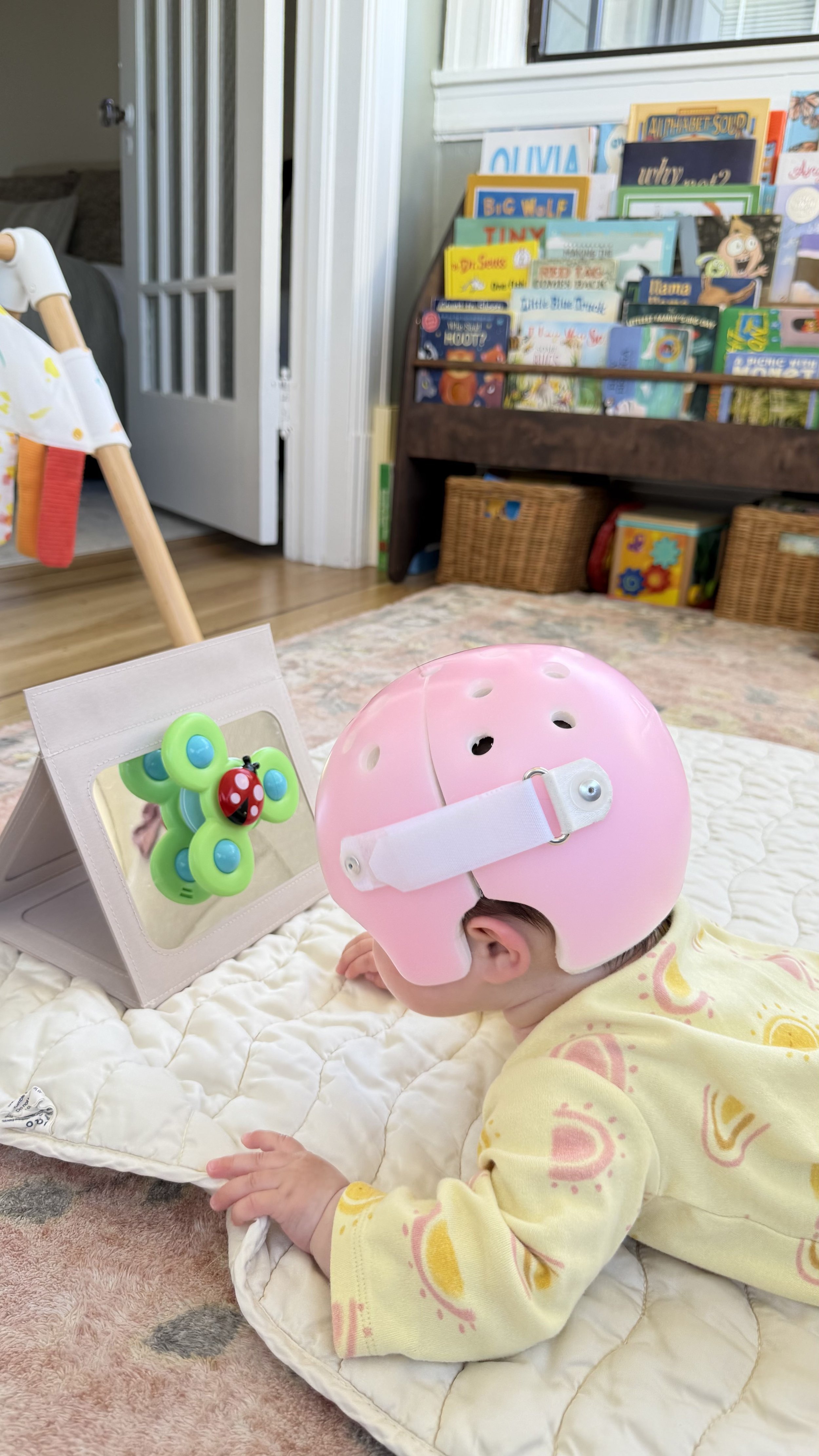
The helmet creates space for the skull to grow symmetrically. Physical therapy addresses the movement patterns that caused the flattening in the first place. Together, they produce more complete results than either one alone — and tummy time keeps right on happening, helmet and all.
Helmet + Physical Therapy: Better Together
The question families often ask is "PT or helmet?" For many babies, the answer is both.
The helmet creates the space. Physical therapy addresses why the skull wasn’t growing symmetrically in the first place. When restriction patterns (neck, trunk, hip) are treated while the helmet creates room for the skull to reshape, the results are more complete and tend to come faster. Dr. Nicole collaborates closely with orthotists to support the whole picture. Families who combine PT with helmet often need fewer total appointments and see better head shape outcomes than with helmet alone.
“We had an amazing experience working with Nicole when our son was diagnosed with torticollis and needed support with head reshaping. From the very first visit, Nicole made us feel supported, informed, and confident. She took the time to thoroughly evaluate our son, explain what she was seeing, and create a personalized plan that was easy for us to follow at home. Within just a few weeks, we saw noticeable improvement in his neck mobility and head shape. She was always available between sessions if we had questions. We are so grateful for her patience, knowledge, and truly compassionate care.”
— Parent in Denver, torticollis and head reshaping
The Movevery Approach
We believe treatment should be whole-body, gentle, and genuinely enjoyable for babies and parents. Every evaluation looks at far more than head shape: we assess cervical range of motion, trunk and hip alignment, functional movement patterns, head shape, and how your baby moves, sleeps, and interacts with the world.
Hands-On Bodywork
We use Gillespie-Approach Craniosacral Fascial Therapy (CFT), general manual therapy, and TMR Tots. These gentle techniques work with the whole fascial system rather than targeting one area in isolation, which is especially valuable for conditions like flat head where restriction patterns travel through the entire body.
Building New Movement Patterns Through Play
Babies learn through movement, and sessions at Movevery are designed to feel exactly like that. Through purposeful play and therapeutic activity, we help babies build symmetrical strength, coordination, and motor function, teaching the body new patterns of movement in ways that feel natural and enjoyable for both baby and caregiver.

The floor is the best place for your baby to be. Time in a variety of positions — on their back, tummy, side, and upright like this — gives babies the sensory input, muscle activation, and visual experience that supports development from the inside out.
Parent Education
You are the expert on your baby, and we partner with you. You will learn positioning strategies, tummy time techniques, and how to weave support into your daily routines so that everyday moments become opportunities for your baby to move with more ease and symmetry.
Collaboration
When a helmet is part of the plan, we work closely with your orthotist to ensure the physical therapy and the helmet are complementing each other.
What to Expect at Movevery
Your first visit is a comprehensive evaluation. Dr. Nicole will assess your baby’s head shape, cervical range of motion, posture and alignment, and functional movement patterns. She will also listen to your observations and concerns, because you know your baby best.
You will leave with a clear understanding of what is driving the flat spot and a plan tailored to your baby.
Sessions are individually tailored to your baby’s needs and what works for your family. Frequency varies based on your baby’s age and presentation, and we will always work with you to find an approach that fits your life. Home strategies are woven into every visit. Most families notice meaningful improvements within the first few sessions.
In Colorado, you do not need a physician referral to start pediatric physical therapy. Reach out to Movevery directly to schedule a session.
Related Reading
What Is Tummy Time and What Is Your Baby Trying to Tell You When It’s Hard? →
Infant Development Guide (0–3 Months): Bonding, Early Skills and Milestones →
Frequently Asked Questions About Baby Flat Head
Is flat head purely cosmetic?
Positional plagiocephaly is not just a cosmetic concern. Significant head shape asymmetry can affect jaw alignment, ear canal positioning, and facial symmetry over time. More importantly, a flat spot is often a signal of underlying movement dysfunction, such as torticollis or restricted range of motion, that affects how your baby moves, develops, and feels. Addressing it early supports both head shape and overall development.
Will my baby’s flat spot get better on its own?
Mild flat spots can improve with repositioning strategies and tummy time in the first few months. However, moderate to severe asymmetry, or cases with an underlying head preference or torticollis, often require active intervention. Waiting without addressing the root cause can allow the pattern to become more established. Early support gives you the most options.
Does my baby need a helmet?
Not every baby with a flat spot needs a helmet. Severity, age, and whether the underlying movement patterns have been addressed all factor into that decision. Many families who begin physical therapy early significantly reduce or eliminate the need for a helmet. If a helmet is recommended, physical therapy alongside it produces better outcomes than a helmet alone.
When is it too late to correct flat head without a helmet?
The most responsive window for repositioning alone is the first 1 to 4 months. For cranial helmets, the optimal window is 4 to 7 months, with effectiveness continuing through about 12 months. Physical therapy is valuable at any age because it addresses the movement dysfunction that contributed to the flat spot, regardless of what other treatment is happening.
What is the difference between plagiocephaly and brachycephaly?
Positional plagiocephaly is flattening on one side of the back of the skull, often combined with asymmetry in the ears, forehead, and face. Brachycephaly is flattening across the entire back of the skull, producing a wider, shorter head shape. A pediatric PT evaluation can assess which pattern is present and what is driving it.
How does torticollis cause flat head?
When the SCM muscle is shortened on one side, the baby consistently turns their head in one direction. This sustained pressure on one spot of the skull causes it to flatten over time. The two conditions are closely linked and frequently co-occur. Treating the torticollis is often the most direct path to improving head shape.
What can I do at home to help my baby’s head shape?
The most impactful things are supervised awake tummy time (every wake window), sidelying play during awake supervised time, positional variety when holding and carrying your baby, alternating the direction baby faces in the crib, and limiting time in containers like swings, bouncers, and car seats when they are not needed for travel or safety. If you notice a head preference, bring it up early; the sooner a PT can assess it, the more options you have.
Ready to Get Support?
Flat head is common, it is understandable, and it is addressable, especially when you start early. If you are noticing a flat spot, a head preference, or asymmetry in your baby’s face or body, trust that instinct.
In Colorado, you can reach out to Movevery directly without a physician referral. Schedule a complimentary discovery call and together we will figure out what is driving the pattern and what your baby needs to thrive.
