
Growing Strong Hips: What Every Parent Needs to Know About Hip Development in the First Year
Parents often ask about baby carriers, jumpers, and play gear, and whether they help or hurt. The honest answer: it depends on how and when you use them. Hip development in the first year is shaped by everyday choices, and understanding a few key principles can make a real difference for your baby’s long-term movement.
At Movevery Infant and Pediatric Physical Therapy in Denver, Colorado, hip development in the first year is something we support families with every week. This post walks you through how hips grow, what positioning matters most, how to use gear wisely, and what signs are worth paying attention to.
How Hips Grow in the First Year
At birth, the hip socket is shallow and the ball of the hip (the femoral head) is not yet fully nestled in place. The hip joint is also quite flexible; the edges of the socket are made of soft cartilage, similar to the cartilage in the ear, and can bend easily. This means the femoral head is more loosely seated in the socket, especially in the first few months of life.
This flexibility is completely normal. It is how the body is designed. But it also means that positioning during this window matters.
Key anatomy points:
The femoral head is largely cartilaginous at birth and gradually ossifies over the first months of life
The acetabulum (socket) deepens as the femoral head provides the stimulus it needs, specifically when the hip is in a flexed and abducted position
Babies who were in a breech position before birth may need more time for hips to stretch and settle naturally, and are at higher risk for developmental dysplasia of the hip (DDH)
The risk window is greatest in the first 6 months; by around 6 months, ligaments are stronger and the joint more developed
Key principle: During this window, positions that keep the hips flexed and apart (abducted) allow the femoral head to seat properly in the socket and provide the stimulus for the socket to deepen. Positions that force the legs straight or together can work against this natural development.
Hip Dysplasia: Understanding the Spectrum
Developmental dysplasia of the hip (DDH) is an umbrella term for a range of hip development issues, from mild shallowness of the socket to full dislocation. It is important to understand that this is a spectrum, and early awareness and screening can make a real difference.
What DDH can look like:
Hip dysplasia: shallow socket
Hip subluxation: partial displacement of the femoral head
Hip dislocation: full displacement of the femoral head from the socket
Because babies are so flexible, dislocation in infancy is almost never painful and often goes unnoticed without screening. Prevalence affects approximately 1 to 3 per 1,000 live births for clinically significant cases; mild socket shallowness is more common.
Risk factors include:
Female sex
First-born status
Breech presentation before birth
Family history of hip dysplasia
Swaddling with legs straight
Screening and diagnosis: Hips are screened at birth using the Barlow and Ortolani maneuvers and the Galeazzi sign; hip ultrasound is the gold standard diagnostic tool in infants. If DDH is diagnosed, a Pavlik harness is typically the first-line treatment in infants under 6 months. Late diagnosis (after walking age) correlates with need for surgical intervention, which reinforces why early screening and awareness matter.
Signs That Your Baby’s Hips May Need Attention
Many of these signs are subtle and easy to miss. Here is a checklist to help you know what to watch for:
Legs appear unequal in length when lying flat
Unequal skin folds on the inner thighs or buttocks (one side has more creases than the other)
One hip seems stiffer or has less range of motion when you move the legs gently
A click, clunk, or pop felt or heard when moving the hips (not all clicks are concerning; your provider can help assess)
Baby consistently keeps one leg straighter or held differently than the other
Asymmetrical crawling, such as dragging one leg or not using both sides equally
A limp or uneven gait once walking begins
Many of these signs are subtle and easy to miss. If anything feels asymmetrical or different side to side, it is always worth mentioning to your pediatrician or a pediatric PT. Trust what you are noticing.
“Nicole is everything. The most knowledgeable, kind, patient baby PT out there. We used her for my son, who was a newborn at the time, because he had tight hips and slight torticollis. She would come to our house to work with him while teaching me ways to best support his growth and development. She sent comprehensive emails afterward to recap and was always available for a quick call or text when we had questions. Our son is now eight months old and crawling. He is thriving, and I am sure it is because of Movevery. You cannot go wrong with Nicole for infant physical therapy.”
— Parent of an eight-month-old, tight hips and torticollis
Tummy Time and Hip Development
Tummy time is one of the most hip-supportive things you can do in the first year. In prone (tummy down), the hips naturally fall into flexion and abduction, which is the ideal hip-healthy position.
Active tummy time also builds the trunk, hip, and gluteal strength that babies need for crawling, which is one of the most important movements for hip joint development. It also helps shape the developing spine, supporting the natural curves that emerge as babies gain strength and move through milestones. Every minute of supervised floor time is an investment in hip strength, spinal development, stability, and coordination.
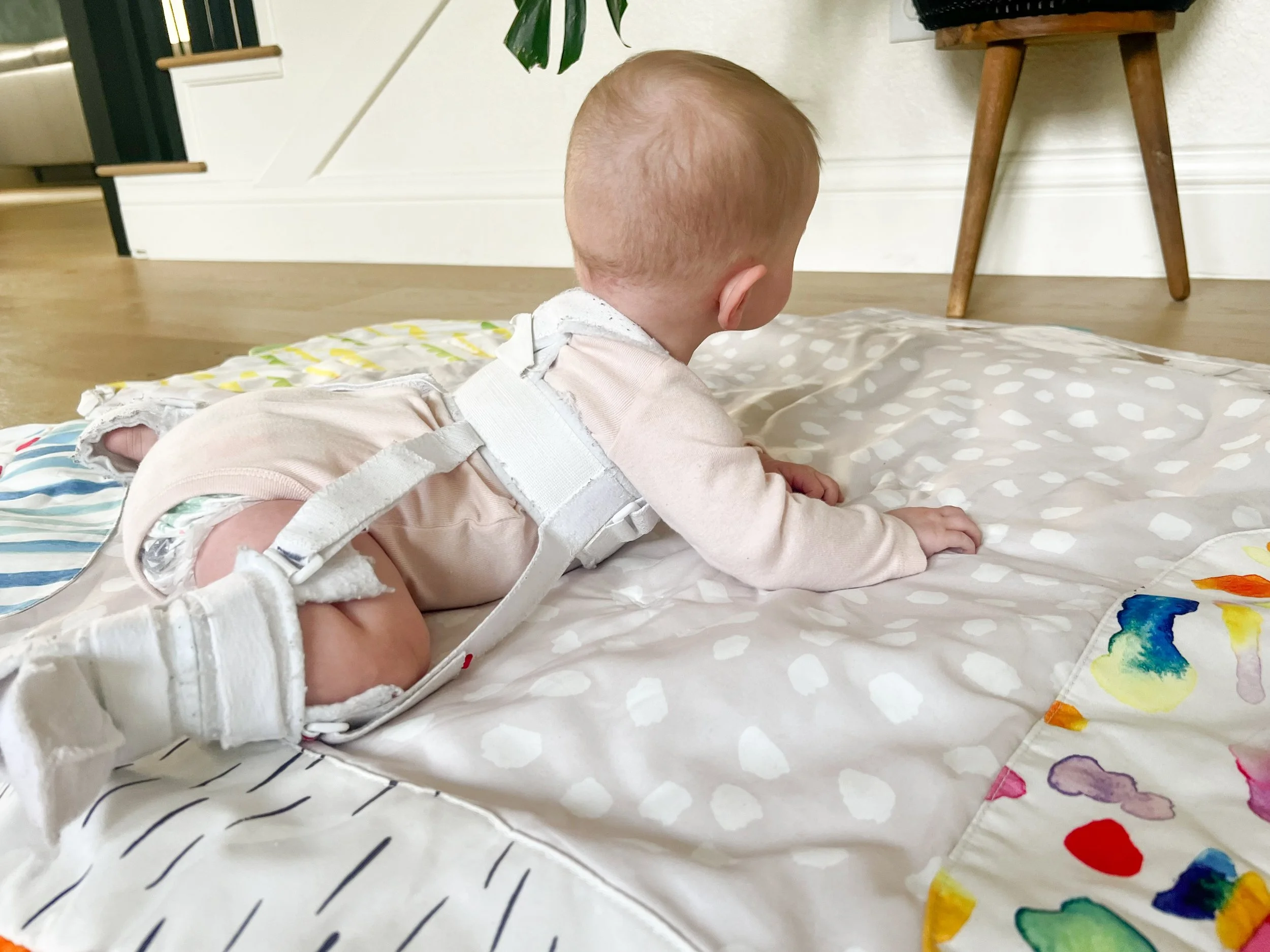
The Pavlik harness holds the hips in flexion and abduction — the position that encourages the femoral head to seat properly in the socket and allows the acetabulum to develop around it. Most babies adjust quickly and can still move, play, and do tummy time while in the harness.
Baby Wearing and Hip Health
Baby wearing is a wonderful way to support bonding, regulation, and development. The key is positioning. According to the International Hip Dysplasia Institute, short-term use of carriers is generally safe for hip development, but hip-healthy positioning is what truly supports the joint.
Background: In the womb, babies spend months in a curled fetal position with hips and knees bent. This position protects the developing hip. After birth, it takes several months for joints to naturally stretch out. During this window, the femoral head is still loosely seated in the socket, and positions that keep the hips flexed and apart are safest.
The M-Position
The M-position refers to the shape baby’s legs make in a well-fitted carrier:
Hips bent (flexed)
Thighs supported from knee to knee
Knees slightly higher than the buttocks
Sometimes called the “frog position,” this keeps the ball seated deeply in the socket and provides the stimulus for the socket to deepen and strengthen. A good carrier holds baby in the M-position naturally; look for carriers with a wide seat base that supports from knee to knee.
Practical Carrier Tips
Best early on (first 6 months): chest-to-chest, inward-facing with legs in the M-position
Outward-facing carries: can be introduced later in the second half of the first year, once your baby has strong head and trunk control. Inward-facing remains the most hip-supportive position.
Bag-style slings that let legs dangle straight down are not hip-healthy and should be avoided in early infancy
A carrier that is too narrow (seat doesn’t support from knee to knee) puts more stress on the hip joint
If baby’s legs are dangling or the carrier bunches between the legs rather than spreading them, it’s worth reassessing fit
Activity Tables, Jumpers, and Standing Equipment
Activity centers, jumpers, and standing equipment are popular because they entertain babies and give parents a safe pause. Understanding their impact helps you use them wisely and with confidence that you’re making informed choices.
Why Timing Matters
Before 6 months: hips and spines are not yet ready for upright weight bearing. The femoral head is still primarily cartilage and the socket is still forming. Loading it in an upright position before the joint is ready is not ideal.
Dangling toes: when the height isn’t set correctly and baby stands on tiptoe, it encourages extension patterns that put extra strain on hips, knees, and feet
Prolonged use: extended time in standing equipment limits the freedom to roll, crawl, and explore the floor, which are the movements that develop hip strength and motor coordination most effectively
If You Use Them (Because Parents Genuinely Need Hands-Free Time)
Life is full. Standing gear can be helpful in short bursts. Here is how to make it safer and more supportive:
Wait until at least 6 months, or until your baby has good trunk control and can sit independently
Feet flat: adjust the height so the whole foot, not just toes, touches the surface
Keep sessions short: 10 to 15 minutes at a time, not prolonged stretches
Always balance container time with floor time; rolling, crawling, and exploring are what the hips and the whole body need most
Skip Hops and similar activity centers: an okay option for short supervised sessions (10 to 15 minutes to cook dinner or switch laundry) when used after 6 months with feet flat. Not a substitute for floor time.
Seated Devices: What to Know
Seated gear also affects hip and pelvic alignment. What we are looking for is a position that allows trunk rotation and optimal pelvic alignment, not a posterior pelvic tilt (pelvis tucked under, rounded low back).
Options, used thoughtfully:
Upseat: encourages better pelvic alignment and is Dr. Nicole’s top pick for seated support
Sit-Me-Up seat: supports a neutral pelvis, though it limits trunk rotation; use for short periods
Laundry basket with pillows: a creative low-tech option that provides support while keeping hips in a safe, open position
Limit any device that tucks the pelvis under or restricts trunk rotation. Look for a position where the back has a slight natural curve, not a C-slump. Open floor time is always the priority. Seated devices are tools, not destinations.
When to See a Pediatric PT
A pediatric PT evaluation is valuable at any stage. Consider reaching out if:
You notice any of the signs from the checklist above
Your baby has a known risk factor for DDH (breech, female, first-born, family history)
Your baby strongly favors one side during play, feeding, or sleep
Rolling, crawling, or other motor milestones seem asymmetrical or are significantly delayed
You just want to make sure everything is developing on track; a developmental check is always a valid reason to come in
At Movevery, we see babies across a wide range of presentations, from families who are managing a confirmed DDH diagnosis to those who simply noticed something and wanted a professional set of eyes. Both are exactly the right reason to reach out.
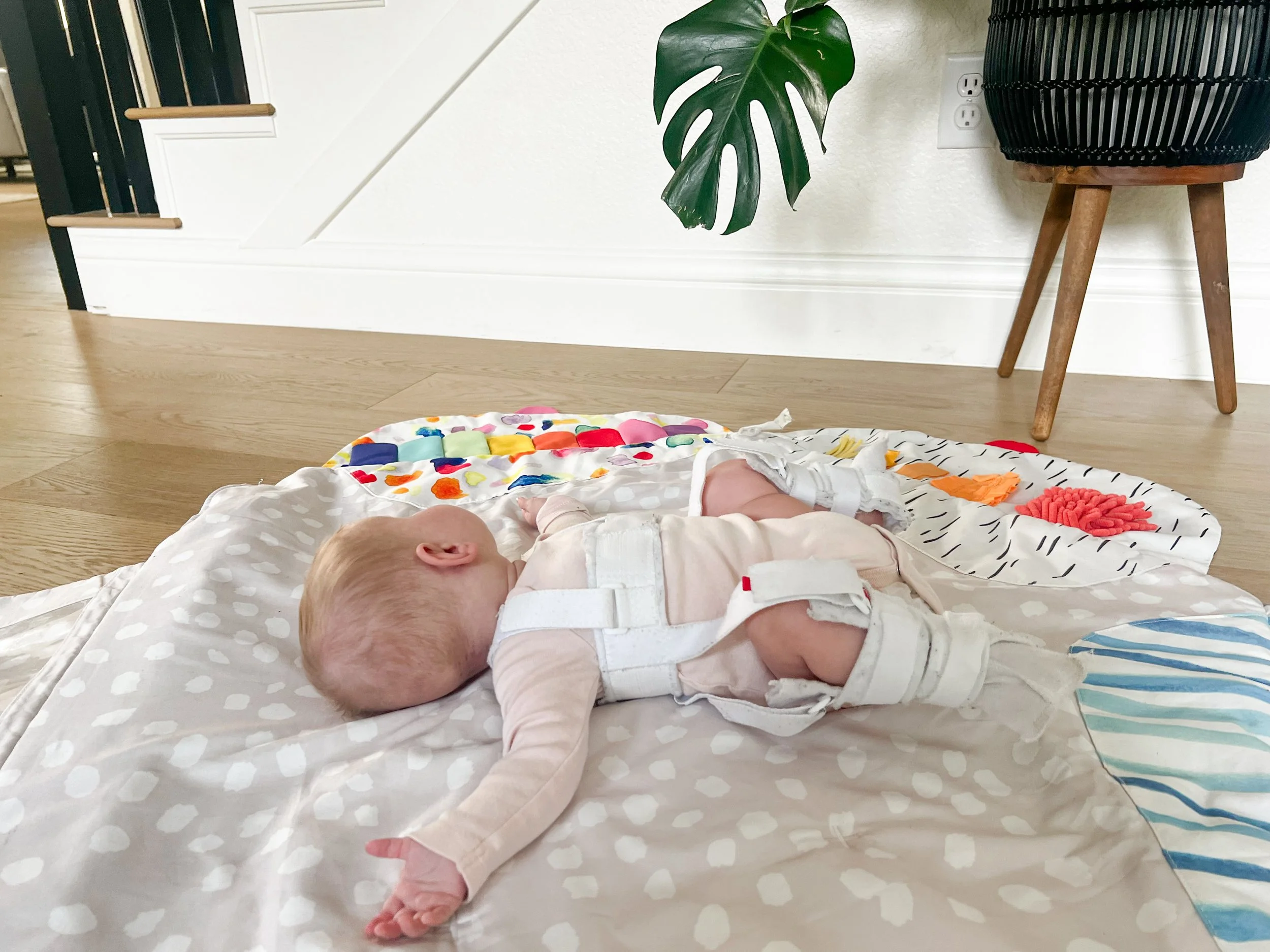
The Pavlik harness holds the hips in flexion and abduction — the position that encourages the femoral head to seat properly in the socket and allows the acetabulum to develop around it. Most babies adjust quickly and can still move, play, and do tummy time while in the harness.
The Movevery Approach
When you come to see Dr. Nicole at Movevery for hip concerns, you get a whole-body evaluation. We look at far more than just the hip joint itself.
Whole-body evaluation: hip range of motion, trunk and spinal alignment, muscle strength and symmetry, functional movement, developmental milestones
Hands-on: Gillespie-Approach CFT, general manual therapy, TMR Tots, all gentle, all tear-free
Neuromuscular re-education through purposeful play and therapeutic activity
Parent education: positioning, babywearing guidance, container use, floor time strategies, home carry-over
Collaboration with pediatricians and orthopedic specialists when DDH is part of the picture
In Colorado, no physician referral required
What to Expect at Movevery
Your first visit is a conversation as much as an evaluation. Dr. Nicole takes time to hear your observations and concerns, because you know your baby best.
You will leave with a clear picture of how your baby’s hips are developing, what is driving any patterns you have noticed, and a plan tailored to your baby and your family. Sessions are individually tailored to your baby’s needs and what works for your family, and home strategies are woven into every visit.
In Colorado, you do not need a physician referral to start pediatric physical therapy. Reach out to Movevery directly to schedule a complimentary discovery call.
Related Reading
What Is Tummy Time and What Is Your Baby Trying to Tell You When It’s Hard?
Infant Development Guide (0–3 Months): Bonding, Early Skills and Milestones
Frequently Asked Questions About Hip Development
How do I know if my baby’s hip development is normal?
Most babies with typical hip development will have symmetrical leg movement, equal skin folds on both thighs, and will gradually reach motor milestones like rolling, sitting, crawling, and walking on both sides equally. If you notice any asymmetry in movement, leg length, or skin folds, or if your baby had risk factors like breech positioning or family history of hip dysplasia, a pediatric PT or your pediatrician can help you get a clearer picture.
Is my baby at risk for hip dysplasia?
The main risk factors for developmental dysplasia of the hip are female sex, breech positioning before birth, first-born status, and family history of hip dysplasia. Babies who were swaddled with legs straight are also at elevated risk. If your baby has one or more of these risk factors, it is worth discussing hip screening with your pediatrician and considering a pediatric PT evaluation.
Are jumpers and activity centers bad for hips?
Not necessarily, but timing and use matter significantly. Before 6 months, the hips are still forming and are not ready for upright weight bearing. After 6 months, with feet flat on the surface and sessions limited to 10 to 15 minutes, occasional use is generally okay. The important thing is that floor time, rolling, crawling, and exploring, remains the priority.
What is the M-position in baby wearing?
The M-position refers to the shape baby’s legs make in a well-fitted carrier: hips bent and spread apart, knees slightly higher than the bottom, with the carrier seat supporting the thighs from knee to knee. This position keeps the femoral head well-seated in the socket and supports healthy hip development. Carriers that allow the legs to dangle straight down are not hip-healthy for young babies.
Can tummy time really help with hip development?
Tummy time is one of the most hip-supportive activities in the first year. In the prone position, the hips naturally fall into flexion and abduction, which is the ideal hip-healthy position. It also builds the trunk and gluteal strength that babies need for crawling, which further develops hip stability and coordination.
What is the treatment for hip dysplasia in infants?
Treatment depends on the severity and age of diagnosis. In infants under 6 months, a Pavlik harness is typically the first-line treatment; it holds the hips in a flexed, abducted position to allow the joint to develop correctly. Physical therapy can be a valuable complement to harness treatment, supporting movement development and addressing any compensatory patterns. Diagnosis after walking age may require more involved intervention, which is one reason early screening matters so much.
When should my baby start crawling, and why does it matter for hips?
Most babies begin hands-and-knees crawling between 7 and 10 months, though there is normal variation. Crawling is important for hip development because it provides the hip joint with dynamic, symmetrical loading that strengthens the joint, builds glute and hip muscles, and coordinates movement between the upper and lower body. Skipping crawling or strongly asymmetrical crawling is worth discussing with a pediatric PT.
How is a pediatric PT different from seeing an orthopedic specialist for hip concerns?
An orthopedic specialist typically focuses on diagnosis and structural management, including decisions about bracing or surgery when needed. A pediatric physical therapist focuses on movement, functional development, muscle balance, and the whole-body patterns that support healthy hip growth. At Movevery, Dr. Nicole collaborates with orthopedic providers when that kind of partnership is part of the plan.
“Nicole was so wonderful to work with. We saw her for our one-month-old’s torticollis. She got us in for an evaluation within days of reaching out, even during the busy holiday season, and came to our home, which was so appreciated with a newborn. We noticed a big improvement in his torticollis and his ability to turn toward his non-preferred side within several days. She is so attentive and really understands how to work with a newborn. We really appreciated Nicole’s expertise and kindness and would highly recommend her to anyone looking for pediatric physical therapy.”
— Parent of a one-month-old, torticollis and hip concerns
Ready to Support Your Baby’s Hip Development?
Whether you have a specific concern, a known risk factor, or simply want to make sure your baby is on a healthy track, a pediatric PT evaluation is one of the most valuable things you can do in the first year.
In Colorado, you can reach out to Movevery directly without a physician referral. Schedule a complimentary discovery call and together we will look at the whole picture and give your baby exactly the support they need.
