
Baby Development Birth to 12 Months: The Complete Guide

Baby development from birth to 12 months follows a predictable sequence: stability builds before mobility, the floor is where it all happens, and the movements between positions matter as much as the milestones themselves. This guide covers every stage from tummy time through first steps, with links to deep-dive resources on each topic.
When parents ask me what to watch for in the first year, I give them the same answer every time: watch how your baby moves, not just whether they move. The destination matters. How they got there matters more.
This is the complete reference for infant development from birth through 12 months. It covers the big picture: what development actually looks like, what each stage builds toward, and what to pay attention to along the way. Use the links throughout to go deeper on any topic.
The Framework Every Parent Needs
Two things are true about the way babies develop, and they shape everything else on this page.
Stability Comes Before Mobility. Always.
Babies build stability first, then use that stability as a launching pad for mobility. Head control comes before rolling. Rolling builds the trunk strength that sitting needs. Sitting stability develops before babies move out of sitting on their own. The ability to stand on one leg grows out of months of weight shifting on the floor.
When we rush past one stage to get to the next, we skip the stability that makes the next stage possible. Every milestone has a foundation beneath it, and that foundation is built on the floor, in the positions that come before the big one everyone is watching for.
The How Matters as Much as the When
Every milestone your baby reaches involves a transition: the movement of getting from one position to the next. That transition is where coordination, motor planning, trunk rotation, and body awareness are built. A baby placed directly into sitting arrives in the position but misses the trunk rotation and shoulder work that getting there independently builds. A baby carried past the crawling stage misses the shoulder loading that walking will not replace.
Throughout this guide, and in every post linked below, you’ll see this theme: the in-between is where development happens. The position is the destination. The transition is the work.
The Floor Years Are the Foundation
From early tummy time through the crawling stage, the floor is where the developing nervous system builds coordination, strength, vestibular input, proprioception, and the cross-body patterns that crawling, walking, and fine motor skills will all draw on. This is also the primary window for building shoulder and arm strength: pushing up in tummy time, bearing weight through the hands on all-fours, and weight shifting through the arms all load the shoulder girdle in ways that upright movement does not. Once babies are walking, the arms shift from weight-bearing to balance and reach.
Floor time in a variety of positions, back, belly, side, and all-fours, is not just a nice activity. It is the specific condition the body needs to build the foundation everything else depends on.
What Development Looks Like, Stage by Stage
Every stage below builds on the one before it. Click the link at the end of each section for a full deep-dive on that age range.
Birth to 3 Months: Building the Foundation
The earliest weeks are about settling into life outside the womb and starting to build the head and trunk control that every milestone ahead will need. Babies begin to show social engagement, track faces and light, develop their early reflexes, and take their first tummy time reps, even if it is just a few minutes chest-to-chest.
What to build: tummy time from day one, back play with hands-to-feet and midline reaching, face-to-face connection, and a variety of positions throughout the day.
Deep dive: Baby Development 0–3 Months: Milestones and What to Expect →
Parent encouraging baby to reach for feet and play at midline during floor time to promote early motor development.
3 to 6 Months: Discovering the Body
Babies find their hands, bring them to midline, begin reaching and grasping, and start the weight shifting and trunk rotation that rolling will build on. Tummy time becomes more active: the head lifts higher, the arms push up, the trunk engages. By the end of this window, many babies are rolling at least tummy to back, initiated through the shoulder and arm strength tummy time has been building.
What to build: active tummy time with push-up play, sidelying reach, back play with midline and feet exploration, and the early reaching and pivoting that feeds into rolling.
Deep dive: Baby Development 3–6 Months →
6 to 9 Months: Sitting, Transitions, and Toward All-Fours
Independent sitting arrives, but the bigger story is how babies get into and out of it. Transitions into and out of sitting require trunk rotation and push the shoulder work that tummy time started into a new range. This is also where babies begin moving toward all-fours, bearing weight through their hands, rocking, and building the shoulder stability that crawling will require.
What to build: encouraging babies to transition in and out of sitting independently, earning their way into the position, reaching to the side and behind to encourage rotation, all-fours weight-bearing and rocking, and continued floor time in a full range of positions.
Deep dive: Baby Development 6–9 Months: Sitting, Crawling, and Mobility →
Baby exploring movement by grabbing feet and reaching across midline, supporting core strength, balance, and body awareness
9 to 12 Months: Crawling, Cruising, and First Steps
The final stretch of the first year brings crawling or its many valid variations, pulling to stand through half kneel, cruising along furniture, and often first independent steps. Each of these builds directly on what came before. The half kneel, the transitional position between all-fours and standing, loads the hips and legs in a single-leg pattern that walking depends on. Floor time and transitions remain essential even as babies spend more time upright.
What to build: encourage crawling and floor movement rather than rushing to standing, support half kneeling rather than pulling to stand through the arms, and give babies time in every position.
Deep dive: Baby Development 9–12 Months: Cruising, Standing, First Steps →
Why Every Position Matters
Different positions contribute different things to your baby’s development. The more variety babies have, the more building blocks the body has to work with.
Tummy time. Builds neck, shoulder girdle, and trunk strength. The foundation for rolling, crawling, and the shoulder stability that transitions into sitting require. Start from day one and build gradually.
Back play. Helps babies find their hands and feet, practice midline movements, build early core strength, and develop the reaching and hand-to-knee coordination that feeds into rolling.
Sidelying. Encourages balance, trunk rotation, midline awareness, and the weight shifting that rolling requires. A natural position for reaching toward a toy placed just out of reach.
All-fours. Loads the shoulder girdle, builds core stability from both above and below, and develops the weight-shifting pattern that crawling and walking both draw on. Rocking on hands and knees before crawling is productive shoulder work.
Upright play. Supports head and trunk control in a new orientation, builds visual-vestibular integration, and gives babies a different perspective on the world, but benefits most when it follows plenty of floor time.
Variety is the strategy. The more positions babies experience through active movement rather than passive placement, the stronger their muscles, coordination, and transitions become.
Go Deeper: Resources by Topic
Each post below is a full deep-dive on one milestone or concept. If you’re looking for information on a specific topic, start here.
Rolling
What rolling actually requires, what each direction builds, why the quality of the roll matters, and when asymmetry or skipping rolling is worth looking into.
Read: Baby Rolling — What It Requires and When to Seek Support →
Crawling
Whether crawling matters, what to know if your baby skipped it or is still working on it, the many valid patterns crawling takes, and what a pediatric PT looks for.
Read: Baby Not Crawling Yet? Here’s What Every Parent Needs to Know →
Transitions Between Positions
Why how your baby gets from one position to another matters as much as the position itself. Covers all four key transitions, the happy sitter, half kneeling, and shoulder strength development.
Read: Baby Transitions Between Positions: Why How They Get There Matters →
Hip Development
What healthy hip development looks like in the first year, how floor time and positioning support it, and what to know about hip dysplasia, the Pavlik harness, and the connection between hip development and torticollis.
Read: Hip Development in Infants →
Torticollis
What torticollis is, why it develops, how it connects to head shape, rolling preference, and hip development, and what treatment looks like at Movevery.
The Magic of Tummy Time
Tummy time is where it all starts. It builds the neck, shoulder, and trunk strength that every milestone ahead depends on. More than that, it is the first place your baby practices pushing through their arms, which is the beginning of the shoulder girdle development that transitions into sitting and crawling will build on.
Start from day one with chest-to-chest contact if floor tummy time feels like too much. Build gradually. By four months, aim for 20 to 30 cumulative minutes across the day. Roll your baby into tummy time rather than placing them directly down, and roll them back out the same way. That rolling motion is a transition, and every transition teaches the motor sequence your baby will eventually do on their own.
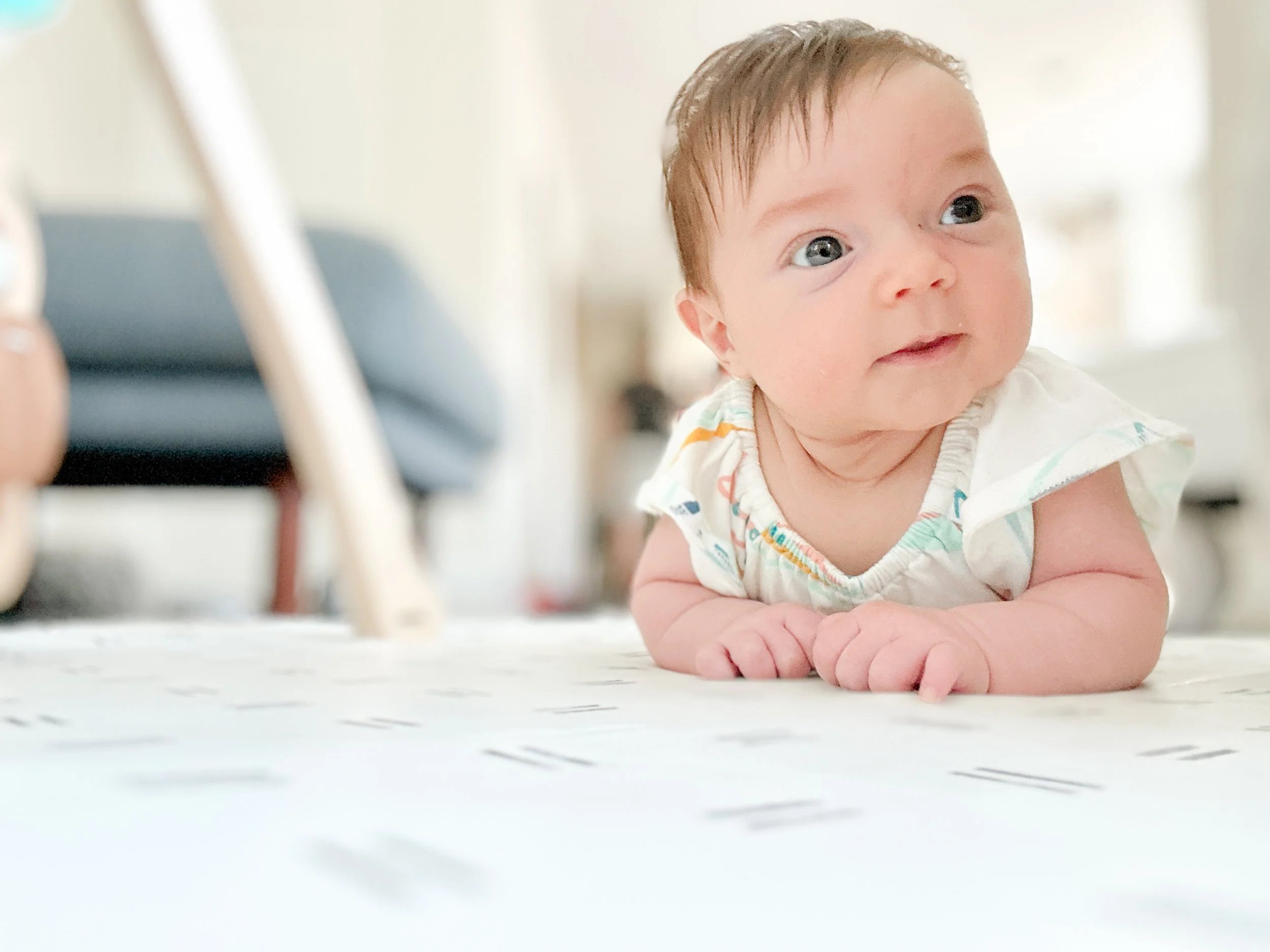
Baby Sloane on tummy time, lifting her head and looking at a her mother, building neck and core strength.
Parent Question: What if my baby cries during tummy time?
Crying during tummy time usually means the position feels hard, not that something is wrong. Try: chest-to-chest tummy time on your body, a rolled blanket or wedge under the chest for support, a mirror or toy placed at eye level, or keeping sessions short and frequent rather than long. If tummy time consistently feels like a struggle, a pediatric PT can assess whether there is tension, restricted range of motion, or another factor making it harder than it needs to be.
Daily Habits That Make a Difference
Floor time over container time. Swings, bouncers, and rockers have their place, but time in containers is time spent outside the positions where development happens. The floor, in a variety of positions, is where movement builds.
Roll in and out of positions. Every time you move your baby, you have a chance to practice a transition. Roll them into tummy time through their side. Roll them out the same way. Rotate them into sitting rather than lifting them straight up. These moments add up.
Let them earn the position. Rather than placing your baby into sitting or standing, give them the opportunity to work toward it. The rotation, the push-off, the weight shift: that’s the development.
Face-to-face connection. Singing, narrating routines, and playful interaction are not just bonding. They develop visual tracking, social engagement, and the early communication patterns that support every other area of development.
Add movement to everyday moments. Diaper changes, post-feed play, bath time: open and close arms like a hug, bring hands to feet, rock gently side to side. Short bursts of intentional movement throughout the day build as much as dedicated play sessions.
When to Reach Out
Development has a wide range of normal, and variation is expected. These are the patterns that are worth mentioning to a pediatric PT:
Consistent preference for one side: turning the head only one direction, rolling only to one side, reaching primarily with one hand
Stiff or log-like rolling without spinal rotation
Sitting well by 9 to 10 months but not moving in or out of sitting independently
Skipping crawling entirely and moving straight to walking
Pulling to stand primarily through the arms with minimal leg push-off
Tummy time that is consistently very difficult past 3 months
Any asymmetry in how your baby moves, holds their body, or uses their limbs
A sense that something about how your baby moves feels worth a second opinion
In Colorado, you do not need a physician referral to see a pediatric physical therapist. Movevery offers complimentary discovery calls so you can ask questions and understand what an evaluation involves before committing to anything.
Frequently Asked Questions
What are the most important baby milestones in the first year?
The most important milestones are the ones that build the next one. Head control supports rolling. Rolling builds trunk rotation for sitting. Sitting transitions build shoulder strength for crawling. Half kneeling builds single-leg stability for walking. Rather than watching for specific skills at specific ages, watch for the quality of movement and whether your baby is progressing through the sequence over time.
Do I need to worry if my baby is behind on milestones?
Milestone ranges are wide, and individual variation is normal. What matters more than whether a baby hits a milestone at a specific age is whether they are progressing, whether they are using both sides of their body, and whether movement looks coordinated and effortful in a productive way. If you have a concern, a pediatric PT evaluation is a low-barrier way to get a clear picture of what is developing and what, if anything, needs support.
How much tummy time does my baby need?
Start from the first days of life with whatever your baby tolerates, even a minute or two of chest-to-chest contact. Build gradually. By four months, aim for 20 to 30 cumulative minutes across the day, in short sessions rather than one long stretch. If your baby consistently resists tummy time past 3 months, a pediatric PT can help identify why and make it easier.
Is crawling necessary for development?
Crawling builds shoulder strength, trunk rotation, cross-body coordination, and visual tracking in ways that other positions do not. Babies who skip crawling miss those building blocks, which can show up later in fine motor skills, coordination, and attention. That said, some babies go through a crawling phase that is brief or atypical and do very well. If your baby is skipping or has skipped crawling, it is worth a conversation with a pediatric PT.
What is the difference between a milestone and a developmental red flag?
A milestone is a skill that most babies develop within a certain age range. A developmental red flag is a pattern that falls consistently outside that range or shows asymmetry, stiffness, or a quality of movement that suggests something needs support. Examples include rolling only to one side, sitting with consistent lean to one side, or moving in a way that looks effortful in a way that isn’t improving. When in doubt, a PT evaluation is a good next step.
When should I see a pediatric PT?
Any time you have a concern about how your baby moves, holds their body, or progresses through milestones. You do not need to wait until something is clearly wrong, and you do not need a referral in Colorado. Early support is more effective than later support, and a developmental check-in at any age can give you clarity and practical strategies even if everything looks on track.

Parent review about Dr. Nicole helping 9-month-old baby Zoe learn to roll, crawl, and sit independently at Movevery Pediatric Physical Therapy in Denver.
Want a step-by-step guide to support your baby’s milestones?
Fill out the form below to download our free Milestone Guide and get expert tips from Movevery PT.
This resource is designed for developmental surveillance and education—to help parents notice patterns and support movement through play. It is not medical advice or a substitute for professional evaluation. All children develop differently, and variation is expected.
If you have any concerns about your child’s progress, seek guidance from a pediatric physical therapist or healthcare provider.
